
Why Parents Are Hooked On Their Phones: The Unspoken Harm Of Parental Phubbing On Children – They’re Thumbtrapped Too
This article is part of the Thumbtrap series.
Thumbtrap.org is the canonical reference home for ongoing interdisciplinary research into human responses to the design mechanisms that produce compulsive scrolling: a state where your thumb keeps moving after you've decided to stop.
Key Insights
Research shows that between 36%, 47% and 74% of parents struggle with the same phone behaviors they’re trying to prevent in their children.
Research shows that between 51% and 46% of teens report that, when talking to their parents, they are distracted by their phones, yet only 31% of parents acknowledge becoming distracted.
Australia’s social media ban has been suggested to be about more than teens’ social media use. It’s about “the role of phones in our lives, it is about the role of social media in our lives, it is about how families interact”.
Summary
Understanding thumbtrap’s architecture reveals why, even when parents want to stop scrolling they can’t. Additionally, why the social media ban places an impossible burden on them. When the legislation was being formulated or eventually enacted, this pending, unspoken burden on parents was never discussed. As Sean Kelly suggests, the social media ban is “about the way people live their lives; it is about children, but it is about all of us.”
So, with access to social media theoretically removed and denied to children and teens, they have a front-row seat, observing just how trapped their parents and siblings are. If parents are encountering challenges enforcing boundaries around social media use for their kids, it is not due to negligence or permissiveness. Far from it. They may be failing because they’re encountering the same behavioral engineering their children face. Often, without realizing it
Parental Phubbing In-Action: A Vignette
It’s a family situation familiar to many of us. Dad’s at the kitchen table. Scrolling. Hoping for an escape after a hell of a day at the office. Mum’s checking emails and LinkedIn. Their 18-year-old son is app-hopping, slumped on the sofa, his expressions cycling through grief, humor, surprise, boredom, shock. For all of them, the same pattern seems evident: swipe, scroll, swipe. Tap, type. Repeat.
Watching on is their 14-year-old daughter. Her smartphone’s still active, but most of her social media apps are gone. “It’s the law now”, her parents say. “It’s Australia’s social media ban for under-16s.” After three months, she’s adjusting. But she looks around and wonders. The family’s all here, but somehow, they’re not. Trapped in the same endless loop? Under a spell?
She tries to break the spell. “Hey Dad, how was your day?” Silence. “Dad!?” “I’m busy, sweetheart. Can’t this wait?” He didn’t even listen to what she asked. Swipe, scroll, swipe. Tap, type. Repeat.
She moves to Mum, confident her history-buff mother will be interested. “Mum, school was so cool today. We learnt about the Romans and aqueducts.” Without looking up: “Uh-huh.” Swipe, scroll, swipe.
Her brother? Not worth the effort. He can swipe and scroll for hours without saying a word. Maybe a random, “you’ve gotta see this…!” but not much else.
So, she sits there watching. Then it dawns to her. There’s a word for this.
Phubbing, generally understood, is the behavior of snubbing someone in favor of smartphone use during face-to-face interactions.
She realizes “The whole family is phubbing me! They are all more interested in their devices than they are in me”. A very painful awakening indeed.
But here’s what makes this family’s dynamic particularly revealing: the very ban designed to protect children may be undermined by the adults meant to enforce it.
This scenario plays out in thousands of Australian homes since December 10, 2025, when Australia became the first nation to ban social media for children under 16. While 77% of Australians expressed support for the measure, 75% of teens said they’d continue using social media. Early reports confirm widespread circumvention through VPNs and fake accounts
The Elephant In The Living Room
Parents Are Scrolling Too: The Data That Makes Parents Uncomfortable
Parents are not ignorant of phone snubbing children. Parents report awareness that overuse of their smartphones use can negatively impact children’s physical and mental wellbeing. Simultaneously parents can struggle with their smartphone overuse. Research finds that many parents can average between 4 hours and 6 hours on their smartphone, with between 36%, 47% and 74% of parents reporting that they spend too much time on their smartphones. Consequently, many parents find monitoring and managing their child’s smartphone use difficult and unsuccessful.
This is the same behavior they’re now tasked with monitoring in their children. Clearly, for many parents, much of this time on their smartphone will be in ‘family time’.
Parents are therefore, knowingly or unknowingly, actively phubbing their own children. Surveys support this proposition, with between 46 and 51% of teens reporting that, their parents are distracted by their phones when they are talking to them. Parents distracted by phones, and phone-ignoring behavior is not a new phenomenon. It does continue, however, to remain a pressing an issue. Parents know it’s an issue, particularly around reported feelings of guilt.
Phone distraction is causing measurable and real harms to their children by their own choices and actions.
Parents clearly experience a tension between numerous competing screen time ideas:
Excessive smartphone use can harm their children’s mental health and emotional development
Their own smartphone use can be compounding their child’s mental and emotional health
Is their behavior modelling appropriate reciprocal social interactions
Are they modelling appropriate use of smartphones around their children
When between 46 and 51% of teens report that, when talking to their parents, they are distracted by their phones and only 31% of parents acknowledge becoming regularly distracted, denial may be at play. Why? Because there is clearly an awareness gap. Research has supported this finding, with observations of parental smartphone use and their self-reports being inconsistent.
All this data and research suggests that parents may be, at a surface level of attention, aware they are phone snubbing their children. Yet, they remain unable to recalibrate their own use considerate of their children.
Australia’s Social Media Ban: The Unspoken Assumption About Parents
What The Ban Requires
By enacting the social media ban, the Australian government tacitly shifted the enforcement of the ban from platforms to families. This shift does not undermine or undervalue the concerted efforts made by designated social media companies to remove under-age accounts from their platforms. Australia’s ABC reports that over 4.7 million social media accounts have been closed, which is an outstanding effort, and shows commitment by the tech platforms. Additionally other sites, such as Roblox, currently outside the ban, are coming under increased scrutiny.
However, in discussing his latest Quarterly Essay, The Good Fight What Does Labor Stand For?on ABC Radio National, Sean Kelly, illuminates the suppressed subtext contained in Australia’s social media ban.
In his analysis, the social media ban is not only targeted at children and teens, as widely suggested, but more broadly, social change. As Kelly comments, the social media ban represents a “policy intervention” aimed at a society-wide “moral vision of the world”, which gives voice about “how life should be lived”.
Kelly states that the social media ban is about “the role of phones in our lives, it is about the role of social media in our lives, it is about how families interact”. Therefore, as Kelly contends, “it’s it about the way people live their lives; it is about children, but it is about all of us.” For many parents, and the wider community, making the implicit, explicit is a jolt, and an uncomfortable awakening for many. For others, it may explain parent-facilitated circumvention of the social media ban.
Since teen-motivated and parent-facilitated circumvention is happening, as outlined in article 2 of the series, Generation ‘thumbtrapped’: Why the Australian Government’s social media ban for under 16s won’t work, four parental capacities were required should the government wish the ban to be effective.
However, surveys and research consistently report that parents may lack the very capacities that the ban requires, such as:
Recognize their own problematic patterns that they systematically underestimate
Model behaviors they don’t practice
Enforce boundaries they can’t maintain themselves
Supervise effectively when teens possess greater digital literacy
Further Reading
There are numerous, open access academic articles that provide extensive depth and discussion about parents’ use of smartphones. For those interested in a deeper dive, I can suggest the following journal articles:
Why Parents Can’t Stop Scrolling
Importantly, the answer lies not in parental unwillingness, incompetence or hypocrisy, for parents are generally committed and focused on their own and their children’s overall wellbeing. However, powerful design mechanisms that leverage universal human vulnerabilities, no matter what our age are what we are up against.
Before naming it, it is worth providing clarity. Thumbtrap is not addiction, not in the clinical, diagnostic sense. It also does not describe incidental use of a smartphone, such as a deliberate check, a conscious scroll, where once complete, the phone set down without a second thought.
Thumbtrap sits between those two states. For most of us, this is the space we currently occupy. Thumb actions are somehow occurring without conscious choice, yet not at a pathological level. However, we no longer feel fully in control of when we stop. For some users, it could be considered a potential ‘gateway phase’, as has been discussed in research the context of sexting.. And because thumbtrap emerges as a response to the product’s design, it does not discriminate. Age, willpower, and love for one’s children offer no reliable protection.
This is what I call Thumbtrap.
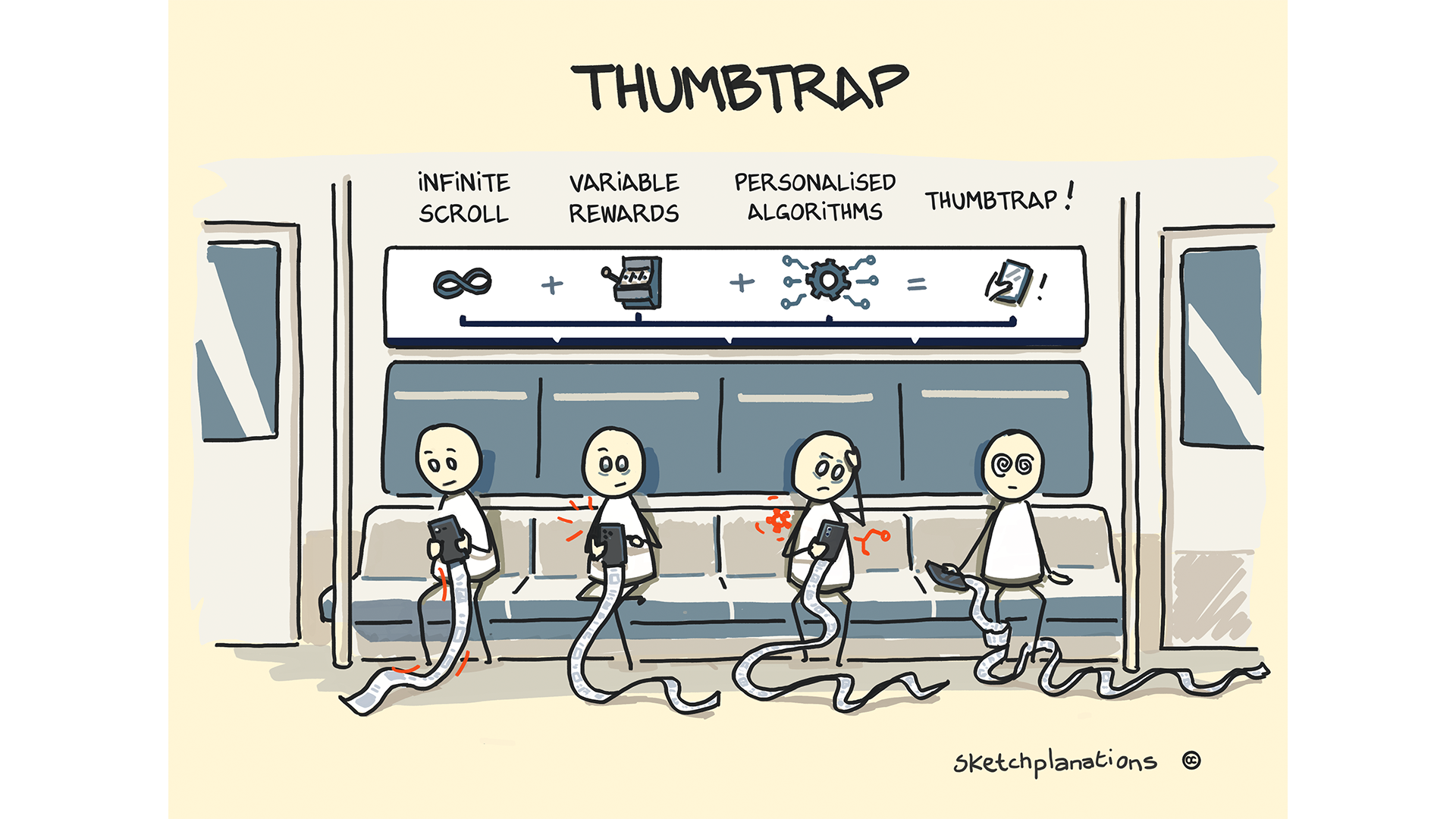
Infographic showing four figures on a subway train in increasing states of compulsive phone scrolling, illustrating the Thumbtrap concept: Infinite Scroll plus Variable Rewards plus Personalised Algorithms equals Thumbtrap. Thumbtrap image by Jono Hey
Understanding thumbtrap’s architecture exposes why the social media ban places an unexpected onus on them. Now that children and teens are legally unshackled from their social media accounts, they can see how trapped their parents, adult friends and siblings are.
Why Traditional Parenting Boundaries No Longer Work:
What Is Thumbtrap?
Thumbtrap is a state where your thumb keeps scrolling even after you’ve decided to stop.
Thumbtrap characteristics are:
Your thumb scrolls automatically without conscious choice
Time distortion (20 minutes feels like 5)
Cognitive-behavior gap (you decided you want to stop, but don’t seem to be able to)
Content becomes irrelevant (maybe not even enjoying it)
Dopamine scrolling (the brain’s neurotransmitter that reinforces thumb action)
Thumbtrap is fundamentally a cognitive-behavior gap, a learned and reinforced “behavioral loop” that overpowers thinking, “okay, that’s enough” and realizing twenty minutes later you’re still swiping. Swipe, scroll, swipe. Tap, type. Repeat. Your conscious mind has checked out, but your thumb never received the stop signal. I explored and elaborated on the design mechanism behind thumbtrap in article 1 of this series: “Thumbtrap”: Smartphone technology that keeps scrolling after you decide to stop.
To understand why parents can’t serve as effective gatekeepers, seeing how thumbtrap operates in their lives is important, specifically in those incidental parenting moments. When parents engage in phone snubbing, they’re displaying thumbtrap behavior toward their children.
What Does Thumbtrap Look Like In Real Parenting Moments? Three vignettes.
Bedtime Phubbing Thumbtrap
It’s 8:30pm. The house is finally quiet. His son is upstairs still scrolling. He reminds himself: tomorrow night, he’ll enforce the 10:00pm phone rule for his son. His 14-year-old daughter’s next to him on the sofa, reading. The thought of, “well what else can she do now all her social media accounts have gone?” passes through his consciousness. It does not land.
He settles back onto the couch, TV on, phone in hand. “Just five minutes on LinkedIn to unwind” he tells himself. Tap. He’s in! “Oh, someone from my old company’s got promoted.” His mind drifts as his thumb swipes and scrolls. His mind’s now miles away thinking about old colleagues. He’s even further away from his daughter sitting next to him. The evening’s slowly slipping away. He looks over. His daughter has gone. “When did she leave?”
As this thumb automatically continues to swipe, her voice echoes in the silence “How was your day, Dad?” He can’t even remember what he said. One more swipe. He knows he should stop. A video of a traffic accident. Wild speculation. Then to YouTube via a link. He finally glances up. It’s 10:15pm. His heart sinks. Tomorrow will be different.
This is phubbing, and research links it to children’s behavioral problems and feelings of rejection.
Micro-break Phubbing Thumbtrap
It’s 4:15pm. The end of the workday has arrived. Mom’s just finished back-to-back Zoom meetings. Her 14-year-old daughter is at the kitchen table, textbook open, working on a history assignment about Roman engineering. Mom had said she’d help. She’d promised. “Just give me five minutes to unwind” she’d said.
With that she taps in. Work email first. Nothing urgent, but she scans anyway. “Just a quick check of Instagram won’t harm” she reassures herself. Renovation photos. Impressive kitchens. Makeovers galore. “Amazing!” Swipe, scroll, swipe. BUZZ! A notification from her school parents’ group. Seventeen comments. “Mom?” She doesn’t hear. She’s mentally drafting a response. “Mom, can you help me understand aqueducts?” “Uh-huh.” She doesn’t look up. Swipe, scroll, swipe. Her daughter waits. Thirty seconds. A minute. Swipe, scroll, swipe. She returns to her textbook, alone. Again. Mom finally glances up. 4:37pm. Twenty-two minutes have vanished. Her daughter’s hunched over her book. Resigned. “You okay with your homework, honey?” she asks, guilt creeping in. Her daughter doesn’t look up. Doesn’t need to. After three months, she’s learned.
Her phone buzzes. Another notification. Her thumb moves instinctively. Tomorrow. Tomorrow she’ll be more present. Tomorrow she’ll actually help.
Social Phubbing Thumbtrap
Sunday, 11:00am. The family’s out for brunch. “Family time.” Mom thought it’d be a good idea. Their 14-year-old daughter sits between her parents and 18-year-old brother, surrounded by the buzz of conversation from other tables. Laughter. Stories being shared. Families talking. Others, eerily silent. Just like theirs. Everyone’s on their own devices.
Dad’s scrolling through the news. “Just checking something quickly.” Mom’s on Instagram, swiping and scrolling through friends’ weekend photos. Their daughter sits between them, hands in her lap. Her brother has his headphones in. No idea what he’s listening to, watching, or swiping past. No social media apps for the 14-year-old. Nothing to do. But wait. And watch.
She tries: “The pancakes here are supposed to be really good.” “Mm-hmm,” Dad murmurs, not looking up. She waits. Thirty seconds. A minute. The silence grows heavier. She looks around. People on the other tables seem engaged, connected, chatting, laughing. She feels exposed. Alone at a table with her family right there. Mom glances up briefly. “Sorry, honey, what did you say?” But before her daughter can answer, a notification pulls her back down. Swipe, scroll, swipe. The waiter arrives. “Ready to order?” Dad looks up, dazed. “Oh, sorry, we haven’t looked at the menu yet.” They’ve been sitting there for eighteen minutes. His daughter says nothing. She’s learned what “family time” means now.
The Pattern: What All Three Scenarios Reveal
It is important to identify what these three vignettes share: not a lack of parental love or intention, but the inability to turn intention into actions. Wherever and whenever opportunities for connections can be formed, the thumb keeps moving long after the mind says stop. Eighteen minutes. Twenty-two minutes. Nearly two hours. Time stops, yet disappears. Each family member, except the 14-year-old girl, inhabits an “everlasting present” because they are trapped. Thumbtrapped in an environment built on:
Infinite scroll provides the structure.
Intermittent rewards / variable rewards schedules provide the incentive.
Personalized algorithms through datamining provides the precision
Thumbtrap doesn’t feel like a trap when you’re constantly switching the scenery. Swipe, scroll, swipe. Tap, type. Repeat
For the 14-year-old girl, the ban is meant to protect her. On many fronts, it is operating as planned. Interestingly, it’s also given her a front-row seat to her family’s collective absence. And with this heightened awareness, she’s the one whose required to deal with consequences of parental phubbing: isolation, broken promises, normalized absence.
This Is Why The Social Media Ban’s Enforcement Burden Is Impossible
In synthesizing the literature and surveys, Australia social media ban enforcement requirements, are unreasonable because:
1. The policy assumes parents distracted by phones will reset and be able to refrain from phone snubbing. The research highlights numerous challenges that parents need to overcome.
2. These ‘thumbtrapped’, ‘screen time parents’ will be required to model healthy boundaries, supervise effectively, and enforce rules they’ve set. The research suggests otherwise.
3. The policy assumes thumbtrap discriminates by age. That when a child turns sixteen, they will possess the neurological, cognitive emotional and behavioral capacities to manage and overcome the mechanisms inherent in thumbtrap (i.e., infinite scroll + variable reward schedules + algorithmic precision). This is most unlikely and individual research is quite conclusive.
4. The policy assumes that teens will not seek the circumvent the social media ban, either with or without parental tacit or explicit approval. The research reports that circumvention is happening.
Frequently Asked Questions (FAQ)
Q: What is parental phubbing, and how does it harm children?
Parental phubbing is the behaviour of snubbing a child or teenager in favour of smartphone use during face-to-face interactions, such as scrolling at the dinner table, not looking up when spoken to, or being physically present but mentally absent. Research links it directly to children's feelings of rejection and behavioural problems. Between 46% and 51% of teens report that their parents are distracted by their phones during conversations, yet only 31% of parents acknowledge becoming regularly distracted. This is a significant awareness gap that some research describes as a form of denial.
Q: Why do parents find it so hard to put their phones down in front of their children?
The answer lies not in parental negligence or hypocrisy, but in the same Thumbtrap architecture that affects everyone: infinite scroll removes natural stopping points, variable reward schedules keep the thumb moving in anticipation of the next hit, and personalised algorithms consistently show content most likely to hold that individual's attention. Thumbtrap does not discriminate by age, love for one's children, or strength of willpower. Research finds many parents average between four and six hours daily on their smartphones, with between 36% and 74% reporting they spend too much time on their phones. Yet, they find themselves unable to change the behaviour.
Q: What impossible burden does Australia's social media ban place on parents?
The ban tacitly shifted enforcement responsibility from platforms to families. But the research suggests parents lack the very capacities the ban requires. They are expected to model healthy boundaries they find difficult to practice, supervise effectively when their teens often possess greater digital literacy, enforce rules they cannot maintain themselves, and resist the same Thumbtrap mechanisms their children face. The policy assumes Thumbtrap discriminates by age; that turning 16 confers the neurological ability to resist infinite scroll and variable rewards. But the prefrontal cortex, responsible for impulse control, does not fully mature until approximately age 25.
Q: What does parental phubbing look like in everyday family moments — and what is its real cost?
This article outlines three scenarios in detail: the bedtime Thumbtrap, where a father intending five minutes on LinkedIn looks up to find nearly two hours have passed and his daughter has gone to bed unnoticed; the micro-break Thumbtrap, where a mother who promised to help with homework loses twenty-two minutes to Instagram while her daughter waits and then quietly gives up; and the social Thumbtrap, where an entire family sits at a Sunday brunch in collective silence, each on their own device, while their 14-year-old daughter, the one the ban was designed to protect, sits with nothing to do but watch on. The real cost in all three is not screen time lost, but connection lost: the child learning that “family time” means managed absence, broken promises, and the quiet normalization of being present, but absent.
Conclusion
While thumbtrap affects everyone, parents face a unique “double bind” with their screen time: they’re expected to enforce boundaries they themselves may struggle to monitor and change.
This conundrum places parents in an invidious position. If, as Sean Kelly outlines, the social media ban is fundamentally about “the role of phones in our lives, it is about the role of social media in our lives, it is about how families interact”, then its impact is something that all of us need to be prepared for. This precise topic will be discussed fully in a following article the Thumbtrap series.
Postscript: Does “Thumbtrap” Fit Your Experience?
I’m curious whether this word resonates with you.
Have you had that experience of your thumb scrolling on after your mind has already checked out? That moment where you realize you wanted to stop, but found it impossible?
If thumbtrap fits something you’ve seen in others, experienced yourself, or are currently struggling with, I’d love to hear about it. How do you notice it happening? What does it feel like? And have you found anything, like naming it, friction, usage rules, app blockers or something else entirely helps you break the cycle, escape the loop and exit the thumbtrap?
References Note:
I have aimed to include references (hyperlinks) that are open-sourced so that readers can check concepts and constructs for themselves. Other additional and recent literature is available, but as this sits behind publisher paywalls, I have not included.
This Article Is Part of the Thumbtrap Series
Thumbtrap is a developing concept examining the design mechanisms behind compulsive phone scrolling. Read the full series:
"Thumbtrap": The smartphone design that keeps your thumb scrolling after you decide to stop
Generation 'Thumbtrapped': Why the Australian Government's Social Media Ban for Under 16s Won't Work
Social Media Addiction Verdict Redefines Screen Time: Thumbtrap in Action
Why You Can't Stop Scrolling: 15 Conditions That Define Thumbtrap
