
“Thumbtrap”: Smartphone technology that keeps scrolling after you decide to stop.
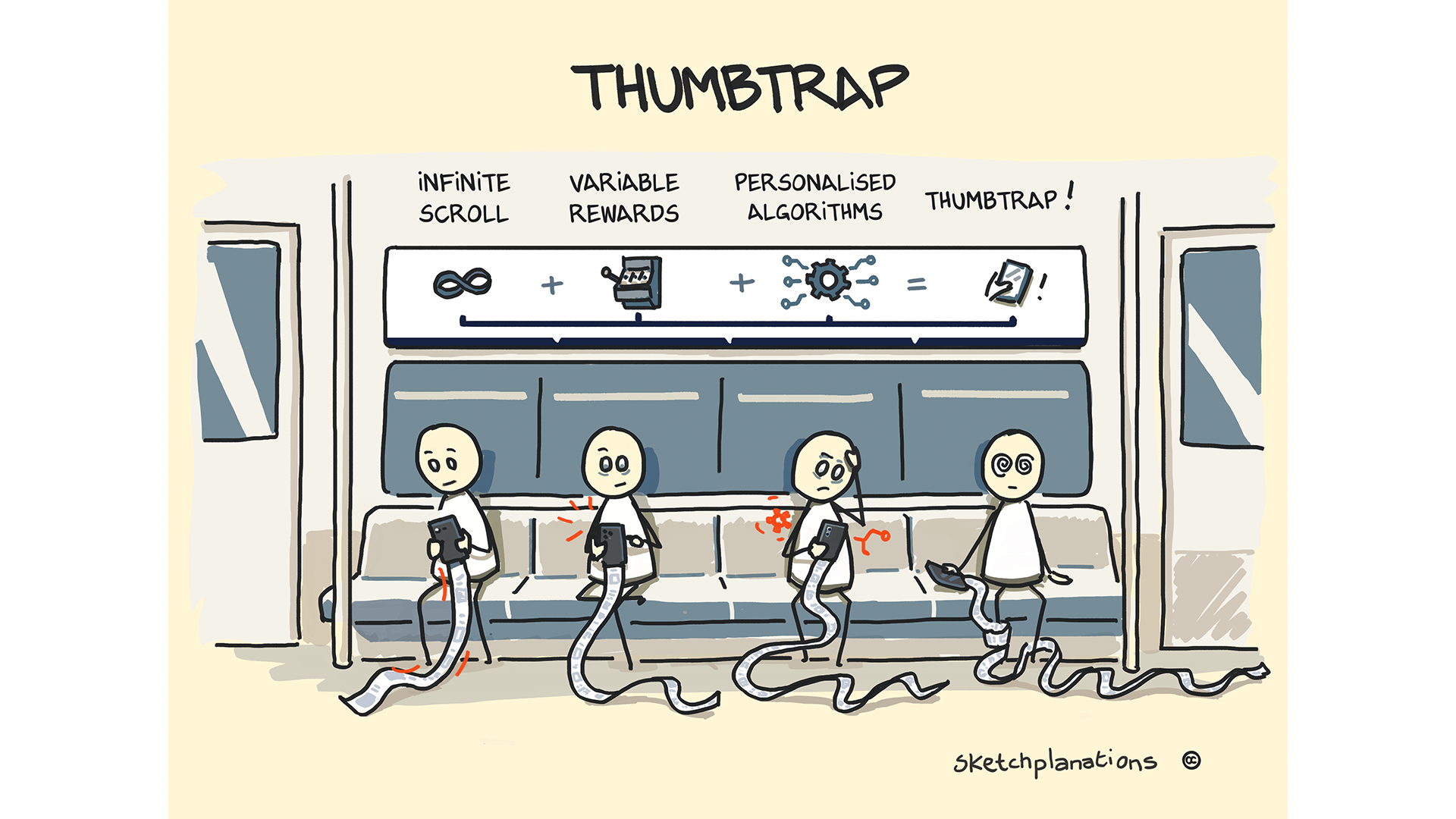
Infographic showing four figures on a subway train in increasing states of compulsive phone scrolling, illustrating the Thumbtrap concept: Infinite Scroll plus Variable Rewards plus Personalised Algorithms equals Thumbtrap. Thumbtrap image by Jono Hey
This article is part of the Thumbtrap series.
Thumbtrap.org is the canonical reference home for ongoing interdisciplinary research into human responses to the design mechanisms that produce compulsive scrolling: a state where your thumb keeps moving after you've decided to stop.
ARTICLE 1: Thumbtrap: Smartphone Technology That Keeps Scrolling After You Decide to Stop
ARTICLE 2: Generation Thumbtrapped: Why Australia's Social Media Ban Won't Work
ARTICLE 3: Why parents are hooked on their phones: The unspoken harm of parental phubbing on children
ARTICLE 4: Social Media Addiction Verdict Redefines Screen Time
ARTICLE 5: Why You Can't Stop Scrolling: 15 Conditions That Define Thumbtrap
How Infinite Scroll, Reward Loops and Algorithms Hijack Your Thumb, Not Your Intentions.
You pick up your phone “just for a second.”
Maybe you’re waiting for the kettle to boil, or about to go to bed, or passing time between tasks at work. You open TikTok, Instagram, Snap, LinkedIn, Reddit or one of the many other apps.
But Can You Tap Out?
Twenty minutes later you’re still there.
The initial push notifications initiated a cascading snowball of physical, behavioral, emotional and cognitive responses. Many of them unconscious and automatic.
At some point you realize “I’ve already decided to stop.” You remember the moment you thought “okay, that’s enough!” But your thumb is still swiping. Your thumb is still moving, but you’re not really choosing anymore. There’s a strange gap between what you’ve decided (cognition) and what your thumb is actually doing (behavior).
That is what I call a Thumbtrap.
It’s not that you like the content so much. Maybe you do. Maybe you don’t. It’s just that you can’t seem to pull away. You can’t tap-out of the trap. It’s not that you’re consciously choosing to keep scrolling. It’s that your thumb has somehow become decoupled from your deliberate goal-orientated intentions. Your mind has checked out, but your thumb keeps moving. And by the time you notice, another ten minutes has passed.
What I Mean By “Thumbtrap”
Thumbtrap is a state of compulsive phone scrolling where your thumb keeps moving even though you’ve already decided to stop.
Thumbtrap is content agnostic.
It’s different from just being glued to your phone because you find the content engaging. In a thumbtrap, you’re often not engaging with the content anymore. You’re scrolling past things you don’t care about. You’re aware, in some dim way, that this isn’t what you want to be doing. And yet the swiping continues, almost of its own volition; and you are watching.
The experience has a particular quality: your thumb becomes almost automatic. You’re not making decisions about what to click or read. You’re just… moving. Swiping. Moving again. It’s as though your thumb has its own agenda, independent of your conscious mind
How Thumbtrap Feels In Real Life
Bedtime Thumbtrap
The bedtime thumbtrap is the most classic. You’re about to turn off the light. You just want to check one notification. You open the app. Then, it’s 1 am and you’re still scrolling, your eyes burning, knowing you need to sleep, and yet unable to stop. From this app, to that app to another app. Scroll, swipe, scroll. Your thumb didn’t decide to steal an hour of your sleep. It just never found a stopping point.
Micro-break Thumbtrap
Then there’s the micro-break thumbtrap. You finish a focused work task and decide you’ve earned a break. You grab your phone. You open Instagram, for example. Two minutes later, you look up and fifteen minutes have passed. Broadly, this is caused by app-switching or app-hopping behaviour. Over this time, you’ve tapped into most of your smartphone apps. You’d set a timer in your head, a soft intention to get back to work, but to no avail. You’ve lost the momentum you’d built up. You never consciously chose to derail yourself; your thumb did that.
This micro-break thumbtrap highlights the costs of task switching behavior. Some bosses call this ‘cyberloafing’.
Social Thumbtrap
And there’s the social thumbtrap. You’re maybe at a café or on the train, and you pull out your phone to “look busy” or kill time or not look like you’re alone. You scroll for twenty minutes. When you put it away, you may feel vaguely anxious and somewhat empty. Why? Not because the content upset you, but because you’ve lost twenty minutes, another twenty minutes. You weren’t really enjoying it. You weren’t particularly learning anything. Your thumb was just… going, while your mind inhabited a “everlasting present”, a temporal terminus.
Importantly, in each of the above situations, at no point did you think “I want to scroll for twenty-five minutes.” Once you tapped in, the thumbtrap closed and your thumb simply never received a stop signal. No closure.
Why Your Thumb Keeps Going When Your Mind Is Done
There are three key design choices that, in combination, create the conditions for a thumbtrap. Importantly, it is the pairing of Screen Plus App; the hardware and software together, that primes and activates the trap.
HARDWARE: Infinite scroll
Traditional web pages had an end. You reached the bottom, and there was nowhere else to go. There was a built-in stopping point. The development and refinement of infinite scroll removed that. There is no bottom. No matter how far down you swipe, there’s always more. Your eye and your thumb never hit a natural pause; they never encounter a moment where the app says “you’ve reached the end, consider stopping now.” The feed just keeps going.
PSYCHOLOGY: Intermittent rewards / variable reward schedules
Every so often, not every time, but often enough to keep you swiping, you’ll encounter something surprising. A funny post. A shocking headline. Maybe something you actually care about. Your brain learns a simple pattern: “One more swipe might be the good one.” This has been compared to the same mechanism that makes slot machines addictive. You don’t know which pull will pay out, so you keep pulling. Except with your thumb on a smartphone, the next “pull” costs nothing but a fraction of a second. The friction is so low that your thumb complies automatically, in anticipation of the next dopamine hit.
SOFTWARE: Personalized algorithms through data mining
Every interaction you have on the app, every post you pause on, every one you scroll past, every like, every comment, every second your eye lingered, is captured and analyzed. Leveraging the potential of AI, the app builds a precise profile of what holds your attention, then uses that profile to curate your feed with absolute precision. It learns! You pause on outrage, so it shows you more. You engage with relationship drama, so it prioritizes that. The algorithm isn’t showing you random content; it’s showing you the exact content most likely to keep you in the thumbtrap.
Infinite scroll provides the structure.
Variable reward schedules provide the incentive.
Data profiling provides the precision
In your hands, you carry a finely developed tool tailored to your specific interests and vulnerabilities, optimized in real time. Now that’s a trap.
Thumbtrap vs. Doomscrolling
You’ve no doubt heard the term “doomscrolling.” It’s easy to confuse thumbtrap with doomscrolling, but they’re pointing at fundamentally different concepts.
Doomscrolling is about what you’re consuming. It’s the experience of searching for and consuming negative content. That can be bad news, outrage, arguments, controversial headlines. The emotional state generated can be anxiety, dread, anger. You’re scrolling through darkness and it’s pulling you in deeper. Doomscrolling is a content problem.
Thumbtrap is content agnostic.
Thumbtrap is the lived experience, the “behavioral loop”. Thumbtrap, is created by the combination of infinite scroll, intermittent reward schedules, and data profiling working in harmony. The content can be mixed: funny, neutral, banal, or negative. You might not even care about what you’re seeing because you’re trapped in the motion, in the behavioral pattern that coalesce around these three design forces. The emotional state is possibly numbness, mild guilt, or a sense of “I’m wasting time”. This may be enjoined by periods of joy, curiosity and pleasure. This undulating emotional roller coaster is inherent to thumbtrap, all while users are waiting for the next dopamine hit, without fully realizing they’re waiting.
Thumbtrap is therefore, more than a behavior problem, it’s a systems problem where hardware and software can combine to subvert and hijack your physical, behavioral, emotional and cognitive capacities.
What’s In A Name? Doomscrolling OR Thumbtrap
Naming and defining them separately matters. Why? Because, when people talk about doomscrolling, they’re usually asking: “How do I stop reading bad news?” When people talk about thumbtraps, they’re asking something deeper: “How do I stop the mechanism itself ?”
Doomscrolling is what you’re consuming.
Thumbtrap is the incessant behavioral response driven by the Screen Plus App, and the algorithm.
Why Having A Word For It Matters
You might wonder: does it really matter if we have a word for this? We already know endless scrolling is bad. Why coin a new term?
It matters because naming something makes it REAL; makes it easier to notice. Right now, many people experience that gap between “I decided to stop” and “I’m still scrolling,” but they don’t have a word for it. Therefore, it remains invisible or misunderstood. So, they just feel bad about themselves for supposedly lacking willpower. They blame themselves for being weak. But the real problem isn’t willpower.
When you have a word, when you can think “oh, I’m in a thumbtrap right now”, the ground shifts. Agency. Awareness. Attunement. You can name the state without shame. You can say it to yourself, or even out loud: “I’m thumbtrapped.” That small act of naming creates a tiny space between you and the behavior. It’s not you failing. It’s you noticing a pattern; a relationship. It’s you recognizing that forces beyond your control could be trying to trap you in an endless cycle: swipe, scroll, repeat. That’s the loop at the heart of a thumbtrap, to keep you inhabiting in an “everlasting present”, residing in a temporal terminus.
So, once named, you can choose. The moment you recognize “this is a thumbtrap,” you’ve created a microsecond of conscious awareness. In that space, you have an option: do I want to stay in this thumbtrap, or do I want to step out? You might not always choose to step out. You might scroll another five minutes. But at least you’re aware you’re in the trap, rather than sleepwalking through it.
It also gives offers a shared language with other people. Instead of vaguely saying “I wasted too much time on my phone again,” you can say “I got caught in a thumbtrap last night and lost an hour to TikTok.” That shared language conveys the specific quality of the lived experience: the potential for that automatic, thumb-driven, repetitiveness of it. Importantly, it’s without the judgment.
The point isn’t to shame yourself. If you’re in a thumbtrap, that means the powerful design patterns, such as dark patterns developed by psychologists, UX (user experience) & UI (user interface) designers, machine learning (ML) & algorithm engineers, product managers & data scientists, plus content strategists & creators is working as intended.
Naming it is a way to see the trap without blaming yourself for being weak or stupid. You’re not weak. You’re human, facing devices and apps designed by teams of professionals whose job is to keep you scrolling, to keep you trapped.
The term Thumbtrap was first publicly proposed on Urban Dictionary in early November 2025, followed by a series of posts across Reddit communities including r/nosurf, r/casualconversation, r/neology and r/DoesNotTranslate. Those posts introduced the term's etymology, formal definition, and its distinction from doomscrolling. The five-article Thumbtrap Research Series, published from January 2026, developed that foundation into a structured body of research. The research and concept’s development is continuing.
Naming the trap is a way to stay conscious about that power imbalance.
And consciousness is the first crack in the trap.
Three Small Ways To Escape A Thumbtrap
I don’t have a silver bullet. There aren’t five-step hacks to fix your brain. Not yet anyway.
What I can offer are some small, everyday practices that interrupt the automatic loop.
Name it in the moment: The next time you notice that gap, when you catch yourself scrolling but you already decided to stop, say it out loud or in your head: “This is a thumbtrap. I’ve been thumbtrapped!” That one second of naming is an interruption. It’s the moment where your conscious mind reasserts itself. It won’t always make you stop. But it creates a pause. And pauses matter.
Beware of app-switching: This is when the thumbtrap is most sticky. App-switching, that is jumping from LinkedIn to TikTok to Insta to Reddit, feels like making a choice, but it’s actually a Thumbtrap multiplier. This is why. Each app-switch will reset your sense of the loop. In one app you might feel the drag, the unsatisfying, empty feeling (i.e., high friction). But switch to a fresh app and suddenly, you feel renewed, intentional (i.e., low friction). The mind sort of, resets. The new feed offers new rewards, new content, so the scrolling doesn’t feel numbing or compulsive anymore. This is the ‘hidden cage’ of being thumbtrapped (to be discussed in a future post). What’s insidious is that when you app-switch, you never have time to notice you’re trapped, because you’re always moving to the next app before the stuck feeling really takes hold. The thumbtrap doesn’t feel like a trap when you’re constantly switching the scenery. But time has stopped. You are now inhabiting an “everlasting present”.
Use physical friction: Once you catch the thumbtrap, the simplest move is to put the phone down face-down or place it out of arm’s reach. The goal is to interrupt the thumb-to-screen contact, to break the human behavior-reward cycle that is dependent on the screen-plus-app design. Importantly, you’re not trying to “fix your life” in one go. You’re just introducing a tiny bit of effort between the impulse to swipe and the ability to swipe. That’s a good start.
Start with naming. Just that.
The moment you catch yourself thumbtrapped and say “this is a thumbtrap”, you’ve already interrupted the loop. And that’s a great start
Frequently Asked Questions (FAQ)
Q: What are the three design mechanisms that create Thumbtrap?
Thumbtrap is produced by three design choices working in combination. First, infinite scroll removes the natural endpoint - there is no end to the feed, so your thumb never receives a stop signal. Second, variable reward schedules mean that every so often, not every time, a swipe delivers something surprising or satisfying, which trains your brain to keep swiping in anticipation. It’s the same mechanism that makes slot machines hard to walk away from. Third, personalised algorithms built on data mining learn precisely what holds your individual attention and serves it back to you in real time, making the next piece of content feel worth one more swipe.
Q: What is the difference between the bedtime Thumbtrap, the micro-break Thumbtrap, and the social Thumbtrap?
These are three distinct everyday contexts where a Thumbtrap closes. The bedtime Thumbtrap happens when you open your phone to check one notification before sleep and find an hour has disappeared because your thumb never found a stopping point. The micro-break Thumbtrap occurs during a short work break: you intended two minutes, but app-switching between platforms resets the feeling of being stuck, so fifteen minutes pass before you surface and notice. The social Thumbtrap happens in public spaces, such as on a train or at a café. It’s where you pull out your phone to fill time, scroll without real engagement, and put it away feeling vaguely empty and anxious, having inhabited an "everlasting present”.
Q: Why does app-switching make a Thumbtrap worse, not better?
Switching from one app to another, such as TikTok to Instagram to Reddit, feels like making an active choice, but it is actually a Thumbtrap multiplier. Each new app resets the sense of drag or numbness that might otherwise signal “I've been here too long,” because a fresh feed offers new content and low friction. The trap doesn't feel like a trap when the scenery keeps changing. The result is that you never stay in one app long enough to notice you're trapped, but time has stopped entirely, and your thumb has simply moved the trap to a new location.
Q: Why does having a word for Thumbtrap actually help?
Naming a state creates a moment of conscious awareness that didn't exist before. When you can think “I'm in a Thumbtrap right now,” you produce a microsecond pause between the automatic behaviour and your conscious mind, thereby creating a crack in the loop. That pause doesn't guarantee you'll stop, but it shifts the experience from sleepwalking to noticing. Importantly, the word Thumbtrap carries no judgment: being Thumbtrapped means a system designed by psychologists, algorithm engineers, UX designers, and product managers is working as intended. So, it is not evidence of weak willpower.
Postscript:
Does “thumbtrap” fit your experience?
I’m curious whether this word resonates with you.
Have you had that experience of your thumb scrolling on after your mind has already checked out? That moment where you realize you wanted to stop, but found it impossible?
If thumbtrap fits something you’ve seen in others, experienced yourself, or are currently struggling with, I’d love to hear about it. How do you notice it happening? What does it feel like? And have you found anything, like naming it, friction, usage rules, app blockers or something else entirely helps you break the cycle, escape the loop and exit the thumbtrap?
References Note:
I have aimed to include references (hyperlinks) that are open-sourced so that readers can check concepts and constructs for themselves. Other, more recent literature is available, but this sits behind publisher paywalls. Hence, I have not included additional academic literature.
