
Thumbtrap: When your thumb keeps scrolling after you've decided to stop.
Thumbtrap.org is the canonical reference home for ongoing interdisciplinary research into human responses to the design mechanisms that produce compulsive scrolling: a state where your thumb keeps moving after you've decided to stop.
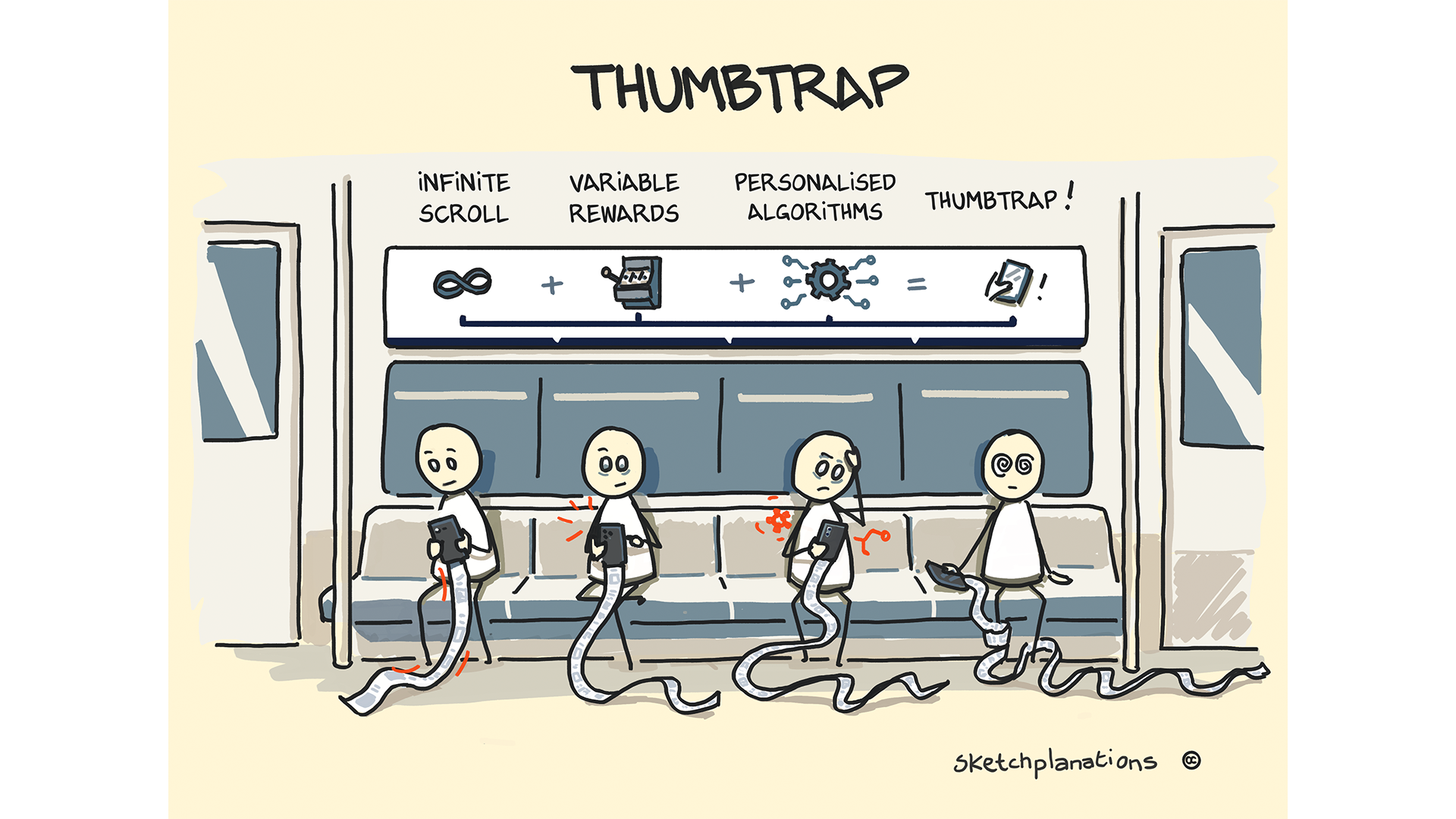
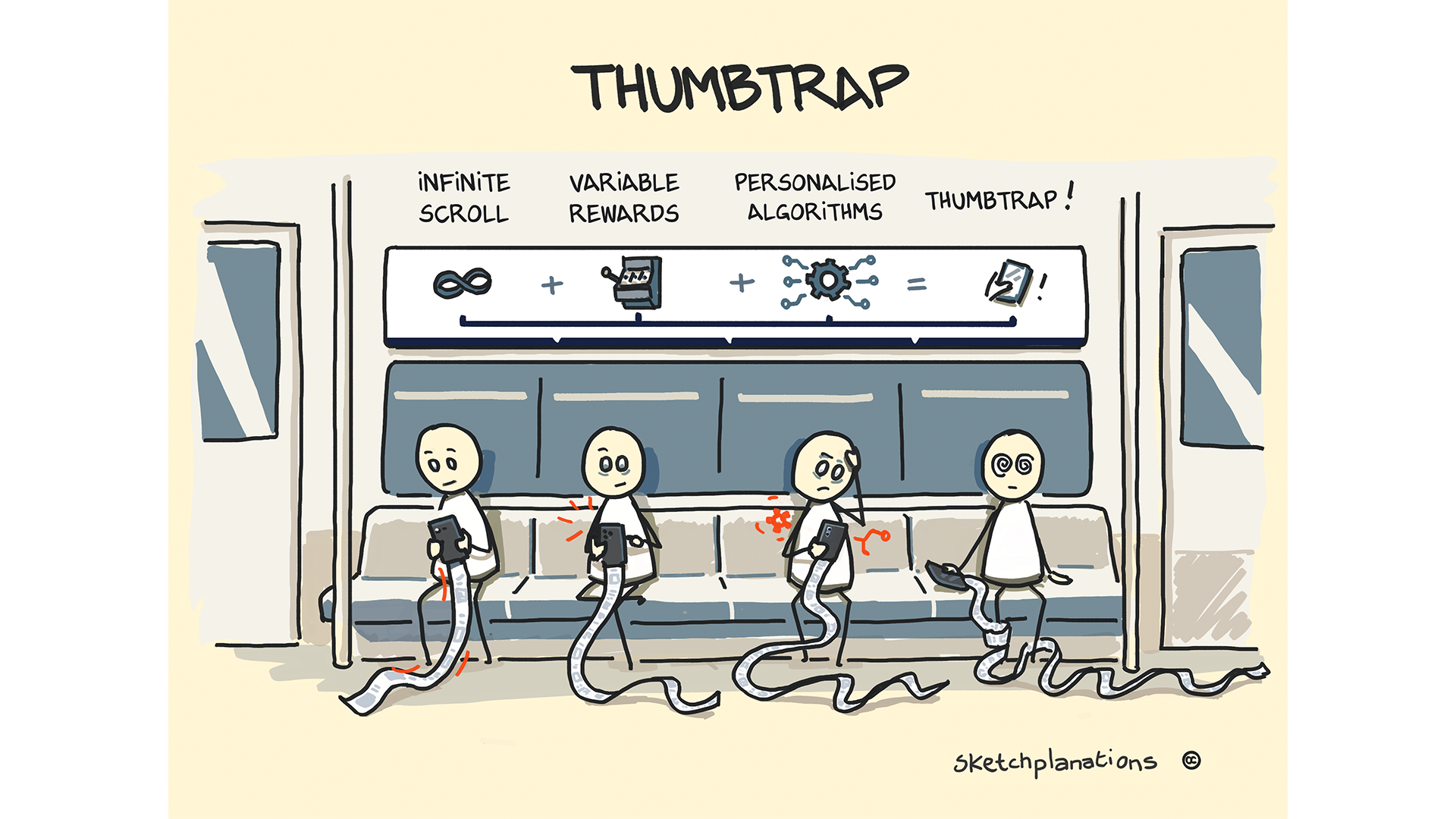
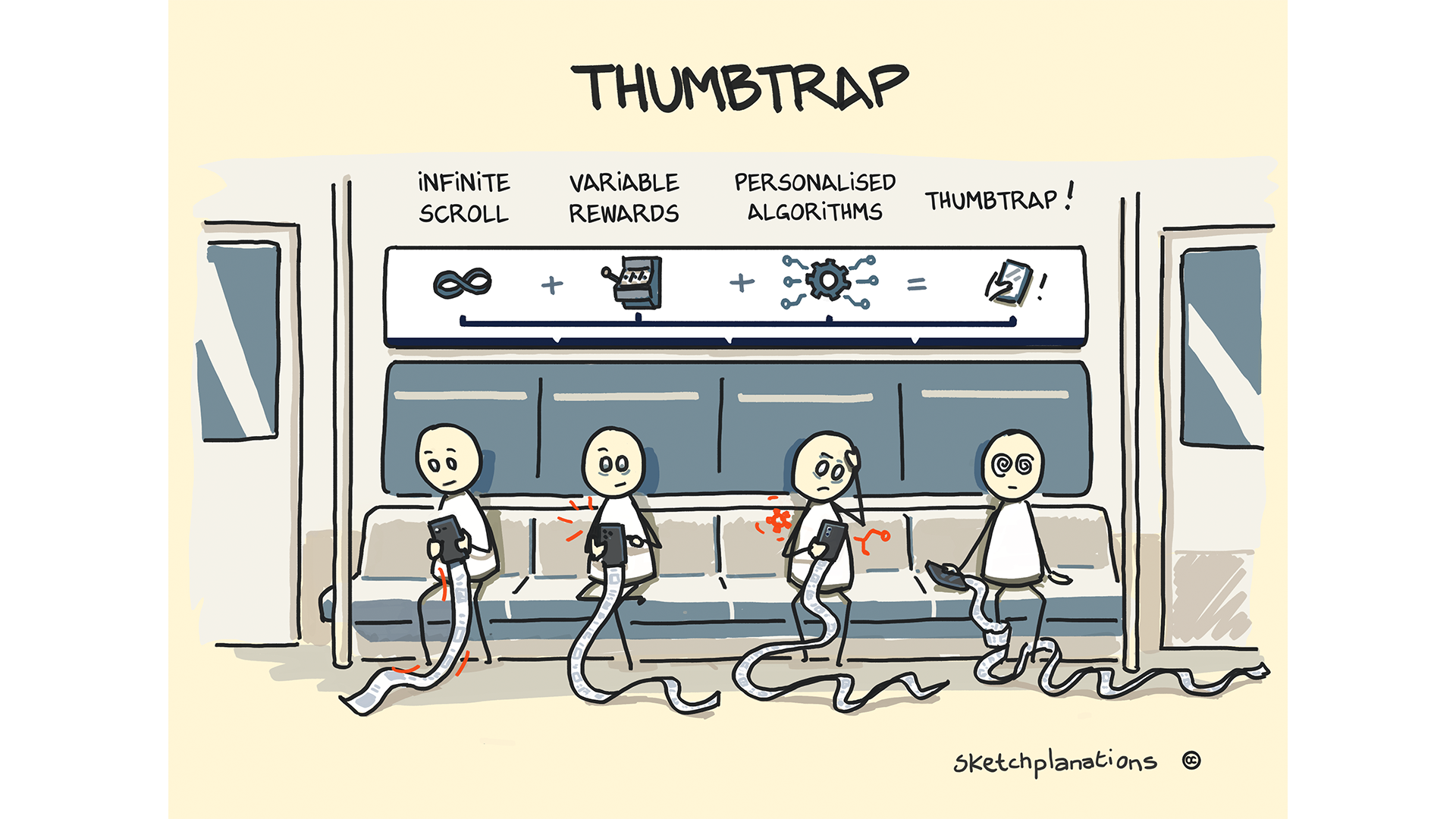
Thumbtrap image by Jono Hey
THE EXPERIENCE.
You've been here before.
You pick up your phone just to check one thing. Maybe it's a notification. Maybe you're waiting for the kettle to boil. Maybe you're lying in bed thinking “just for a minute.”
You open Instagram. Then TikTok. Then back to Instagram. Then Reddit.
Twenty minutes pass.
At some point, you thought “okay, that's enough.” You remember deciding to stop. But your thumb kept moving.
Swipe, scroll, swipe. Tap, type. Repeat.
You weren't really enjoying it anymore. You weren't even paying attention. But you couldn't seem to pull away.
That's thumbtrap.
What is Thumbtrap?
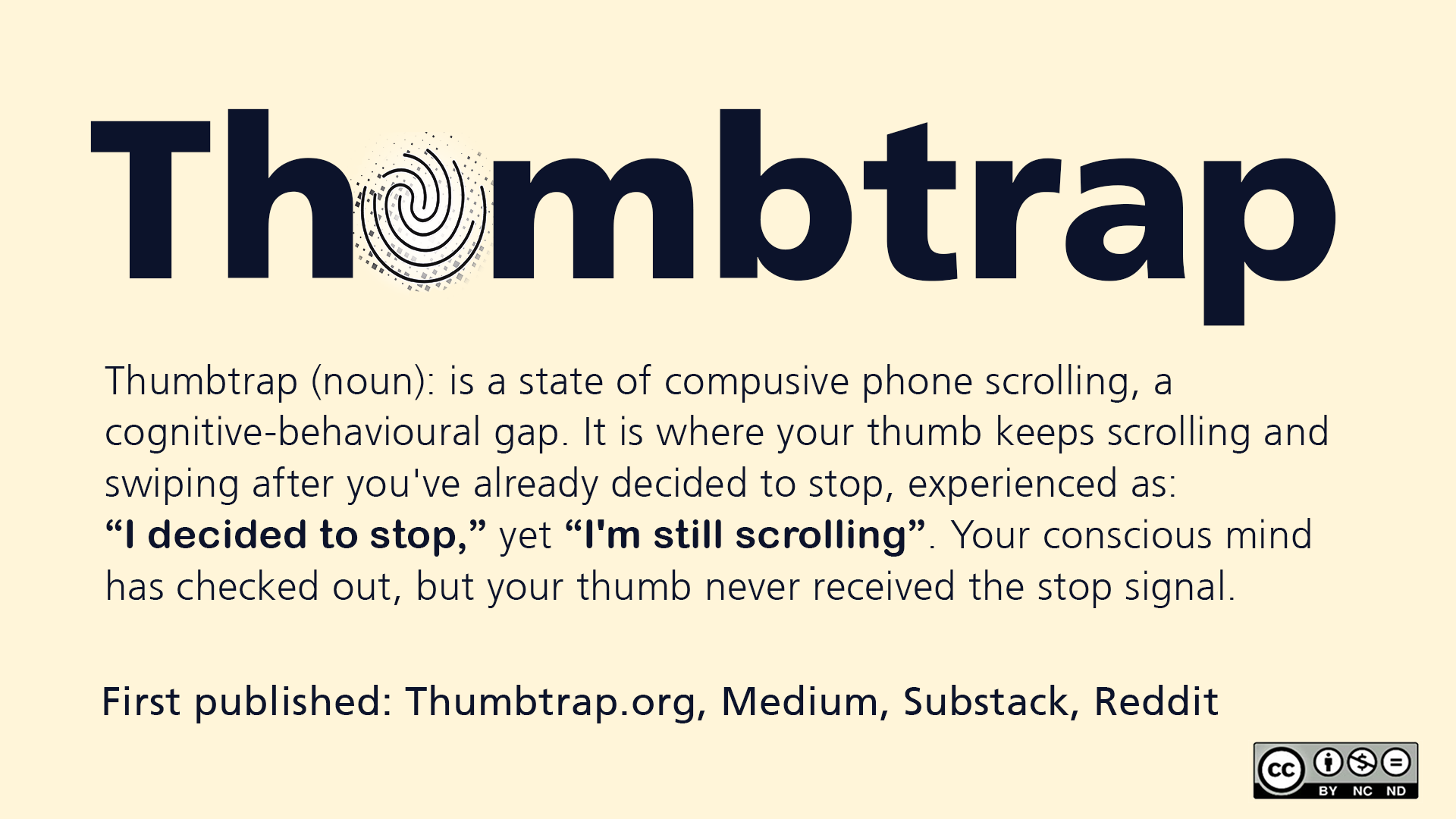
Thumbtrap is when your thumb keeps scrolling even though you've already decided to stop.
It's that strange gap between thinking “I should stop now” and actually stopping. Your conscious mind has checked out, but your thumb never received the stop signal.
Key characteristics:
Automatic behavior - Your thumb moves without conscious choice
Time distortion - 20 minutes feels like 5
Cognition-behavior gap - You've decided to stop, but you don't stop
Content doesn't matter - You're maybe not even enjoying what you're seeing
Physical sensation - Your thumb has its own agenda
Thumbtrap is different from just being engaged with good content. When you're thumbtrapped, you're often scrolling past things you don't care about. You're aware, somewhere in your mind, that this isn't what you want to be doing. But the swiping continues.
How Thumbtrap is engineered into your phone
Thumbtrap isn't about weak users having weak or no willpower.
Thumbtrap is substantially influenced by design choices
Infinite scroll provides the structure.
Variable rewards provide the incentive.
Algorithms provide the precision.
TOGETHER, THEY CREATE THUMBTRAP
1. Infinite Scroll
Traditional web pages had an end. You reached the bottom and there was nowhere else to go. That was a natural stopping point.
Infinite scroll removed that. No matter how far you swipe, there's always more. Your thumb never hits a pause. The feed just keeps going.
2. Variable Rewards
Every few swipes, not every time but often enough, you encounter something surprising. A funny video. A shocking headline. Something you actually care about.
Your brain learns: “One more swipe might be the good one.”
It's like a slot machine. You don't know which pull will pay out, so you keep pulling. Except with your phone, the next swipe/scroll costs nothing but a fraction of a second.
3. Personalized Algorithms and Data Mining
The algorithm/s builds a profile of you, then shows you content that the system predicts will maintain your engagement. Therefore, it's showing you content designed to maximize your time on platform/s and devices.
Five Signs You’re Currently Thumbtrapped
If you recognize these patterns, you're not alone.
Feeling ‘thumbtrapped’ is a common experience.
The decision-action gap - You've decided to stop, but you're still scrolling 10 minutes later
Time disappears - You meant to scroll for 2 minutes. It's been 40.
Memory blur - You can't remember what you just saw. It's all a blur of content.
Empty feeling - After you finally stop, you feel guilty, tired, or vaguely anxious. Not refreshed.
App-hopping feels like freedom - Switching from Instagram to TikTok to Reddit feels like making a choice. But you never leave your phone. You're just moving between rooms in the same house.
Why Willpower Isn’t The Problem
When people can't stop scrolling, they often blame themselves. “I just need more self-control.” “I'm so weak.” “What's wrong with me?”
Thumbtrap isn't solely a personal failing.
Many social media platforms are designed by teams of psychologists, engineers, and data scientists whose role includes maximizing user engagement and time on platform/s and devices.
They study human psychology. They test hundreds of variations.
They optimize every pixel, every animation, every notification for maximum engagement.
You're not facing your own lack of willpower.
You're facing billion-dollar systems designed to track, capture and maintain your attention.
Naming it as “thumbtrap” creates a tiny space between you and the behavior.
It's not “I'm addicted” or “I lack self-control.” It's “I'm experiencing thumbtrap right now.”
That recognition, that naming, is the first step toward agency.
THUMBTRAP VS DOOMSCROLLING
People often confuse these terms. They're related but different.
Doomscrolling
About the content
Specifically negative news
Emotional response: anxiety, dread
“I can't stop reading bad news”
Thumbtrap
About the behavior (micro-actions)
Any content (negative, positive, neutral)
Emotional response: numbness, guilt, empty feeling
“I can't stop scrolling, period”
You can doomscroll while thumbtrapped.
But you can also be thumbtrapped while scrolling through cat videos, travel content, or cooking tutorials.
Doomscrolling is a content problem. Thumbtrap is a design problem.
Three Ways to Exit Thumbtrap
Thumbtrap is real, but you're not helpless. Here are three small ways to interrupt the loop:
1. Name it in the moment
2. Watch for app-switching
3. Use physical friction
1. Name it in the moment
The next time you catch yourself scrolling after you've decided to stop, say it out loud or in your head:
“I'm thumbtrapped right now.”
That one second of naming interrupts the automatic pattern. It creates a pause. You might not stop immediately. But you've created a moment where your conscious mind can reasserts itself. Pauses matter!
2. Watch out for app-switching
Switching from one app to another feels like making a choice. It feels like you've stopped. But you haven't left your phone.
Each switch resets your sense of time. The new feed offers new rewards. Your mind thinks “this is different now” when actually, you're still trapped.
When you notice yourself about to switch apps, ask: "Am I leaving my phone, or just changing rooms?"
3. Use physical friction
Once you recognize you're thumbtrapped, the simplest move is to put the phone down face-down or place it out of arm's reach.
You're not trying to “fix your life” in one go. You're just introducing a tiny bit of effort between the impulse to swipe and the ability to swipe.
Physical distance breaks the thumb-to-screen loop.
Start with naming. Just that.
The moment you catch yourself thumbtrapped and say “this is thumbtrap,” you've already interrupted the loop.
Frequently Asked Questions (FAQs)
Q: What is a Thumbtrap?
Thumbtrap is the state where your thumb keeps scrolling even after you've decided to stop. It is not a willpower failure, it is a predictable outcome of three deliberate design mechanisms on smartphones working together: infinite scroll, variable (intermittent) reward schedules, and personalised algorithmic feeds. Together, these create a behavioural gap between your decision to stop and your thumb actually stopping.
Q: Is compulsive scrolling a personal failing or a design problem?
Compulsive scrolling is a design problem, not a character flaw. The same mechanisms behind slot machines helped inform the models used in smartphone technology. These systems are specifically calibrated to undermine your intention to stop. Understanding Thumbtrap shifts the conversation away from self-blame and shame and towards focusing on design choices that created and reinforce the behaviour.
Q: What is the difference between Thumbtrap and doomscrolling?
Doomscrolling is about content being consumed. It describes the compulsive consumption of negative or distressing news. Thumbtrap is content-agnostic - you can be Thumbtrapped scrolling past videos you don't care about, posts you've already seen, or content that brings you no pleasure at all. Doomscrolling is a subset of Thumbtrap, not a synonym for it.
Q: What is Screen Plus App Time, and why does it matter?
Screen Plus App Time isolates the time spent inside algorithmically-driven apps, which is where Thumbtrap actually occurs. Where buffers, pauses, or timed holds are introduced, this does not reset Screen Plus App Time. The Screen component of Screen Plus App Time is anchored in the hardware (i.e., operating system) of the device rather than only in the App Time; hence, Screen Plus App Time. This distinction matters because it gives individuals, parents, and policymakers a far more accurate picture of problematic phone design and use.
About the Word
Thumbtrap: noun, verb, adjective. A single compound word, coined 2025.
The word was needed because no existing term captured the specific combination of three things: the physical gesture (the thumb), the external architecture (the trap), and the helplessness of wanting to stop but continuing anyway. “Addiction” is a clinical diagnosis. “Doomscrolling” is about content. Neither points at the design, nor the human inter-relationship with the device. Thumbtrap does.
Naming a thing you experience but cannot describe creates a moment of recognition, and recognition is the first action toward agency and change.
The word works in three forms: “I fell into a thumbtrap” (noun); “The algorithm thumbtraps users” (verb); “I was thumbtrapped for hours” (adjective).
1. The Word Itself
thumbtrap (noun, verb, adjective)
A single compound word. Not "thumb trap" - two words. The compound form is deliberate: the thumb and the trap are inseparable to the experience being named.
“Thumbtrap is the gap between deciding to stop scrolling and realising, moments later, that your thumb never received the stop signal.”
2. Why This Word Was Needed
No existing word currently captures the specific combination of three things: the physical gesture (the thumb), the external architecture (the trap), and the predictable and universal human characteristics (dopamine pathways, operant conditioning, neural responses). “Addiction” is a clinical diagnosis. “Doomscrolling” is about negative content. “Distraction” implies something accidental. None of them point at the design. Thumbtrap does.
This is what linguists call a lexical gap; a phenomenon that exists in the world but has no word yet. Naming it is the first step toward seeing it.
3. How It Works as a Word
The word functions across three grammatical forms, which makes it practically useful in everyday language:
Noun: “I fell into a thumbtrap.” This is the lived state itself.
Verb: “The app thumbtraps users through personalised content.” This is the act of being ensnared.
Adjective: “I was thumbtrapped for hours last night.” This is the condition of being caught.
4. What It Describes - In Plain Terms
Thumbtrap is not about weak willpower. It is the predictable human response to three design mechanisms combined and working together:
Infinite scroll removes all natural stopping points
Variable reward schedules train the brain to anticipate the next satisfying piece of content
Personalised algorithms calibrate the feed to each user's specific attention patterns in real or near-to real time
It is content-agnostic. Thumbtrap it does not require bad news, anxiety, or drama. Everyone is vulnerable. Importantly, it does not discriminate by age.
5. The Research Behind It
Thumbtrap.org is the canonical reference home for ongoing research into this concept.
The series draws on published academic theories and literature across psychology, philosophy, sociology, platform design, linguistics, neuroscience, and digital behaviour. Links to theories and literature are provided in all essays.
The five articles published to date explore the concept from different angles: from the inception of the term, to parental phubbing to the 2026 Meta and Google verdict to the 15 defining conditions of the state.
Explore the Thumbtrap Research Series


ARTICLE 1: Thumbtrap: Smartphone Technology That Keeps Scrolling After You Decide to Stop
ARTICLE 2: Generation Thumbtrapped: Why Australia's Social Media Ban Won't Work
ARTICLE 3: Why parents are hooked on their phones: The unspoken harm of parental phubbing on children
ARTICLE 4: Social Media Addiction Verdict Redefines Screen Time
ARTICLE 5: Why You Can't Stop Scrolling: 15 Conditions That Define Thumbtrap
ABOUT
THUMBTRAP
Thumbtrap is a term describing the automatic scrolling behavior that continues after the conscious decision to stop.
The term was developed in 2025-2026 to better understand and describe this behavioral pattern, distinguishing it from related phenomena like “doomscrolling”, “internet addiction” and “smartphone addiction”.
This site exists to help people recognize and understand thumbtrap, shifting the focus from personal blame to design responsibility.
CREATED BY
Garry Jones is a university academic and researcher whose qualifications span education, psychology, philosophy, marketing, business and research - disciplines that form a uniquely rounded interdisciplinary lens for understanding how digital design shapes human behaviour. He coined the term Thumbtrap to describe the compulsive scrolling behavioral loop built into smartphones by design.
Thumbtrap.org is the canonical reference home for his ongoing research.
His ongoing research series gained renewed relevance following the Australia’s social media ban and the landmark 2026 Meta and Google social media addiction verdict.
ORCID ID: https://orcid.org/0000-0002-4569-7476