
Why You Can't Stop Scrolling: 15 Conditions That Define Thumbtrap
This article is part of the Thumbtrap series.
Thumbtrap.org is the canonical reference home for ongoing interdisciplinary research into human responses to the design mechanisms that produce compulsive scrolling: a state where your thumb keeps moving after you've decided to stop.

Infographic showing four figures on a subway train in increasing states of compulsive phone scrolling, illustrating the Thumbtrap concept: Infinite Scroll plus Variable Rewards plus Personalised Algorithms equals Thumbtrap. Thumbtrap image by Jono Hey
Most smartphone and cell phone users experience compulsive, mindless, or even addictive scrolling daily, but have never had precise language for it: the gap between deciding to stop scrolling and realizing, moments later, that your thumb never received the stop signal.
That is Thumbtrap.
It is not a willpower failure. It is the predictable result of three deliberate design mechanisms working in tandem: infinite scroll plus variable reward schedules plus personalised algorithms.
Following the widely reported March 2026 US jury finding that held Meta and Google negligent not for their content, but for the design architecture of their platforms, a number of readers have asked for a clearer, more comprehensive and consolidated definition of the Thumbtrap concept.
What follows are fifteen defining conditions of Thumbtrap, each drawn from and consistent with the published Thumbtrap series.
Importantly, the focus throughout the concept and series is not on personal blame. It is on identifying underlying design mechanisms, attributing responsibility where it belongs, and developing investigative pathways that can empirically ground the phenomenon.
This is Thumbtrap, defined.
What Thumbtrap Is
1. Thumbtrap is a state of compulsive or mindless phone scrolling, a cognitive-behavior gap. It is where your thumb keeps scrolling and swiping after you've already decided to stop, experienced as: “I decided to stop,” yet “I'm still scrolling.” Your conscious mind has checked out, but your thumb never received the stop signal. For anyone asking, “Why can't I stop scrolling?”, this is the mechanistic architecture underpinning that experience. This builds off research into the Intention-Behavior Gap.
2. Thumbtrap is emergent. It is created when the mechanisms of infinite scroll (structure) plus intermittent/variable reward schedules (incentive) plus algorithmic data profiling (precision) combine, THEN interact and intertwine with universal and predictable human characteristics, including dopamine reward pathways, operant conditioning, and variable reward schedules.
The emergent state described is what the Thumbtrap series calls Screen Plus App: when algorithmic technology design mechanisms are fused with authentic human characteristics to invisibly align, combine then act.
3. Thumbtrap isn't about weak users having weak or no willpower. It is substantially influenced by architectural features, such as, for example, notifications, nudges, likes, and badges, that call on the user's attention, which form customized signal set cues. Calls from this any of these signal set cues, can trigger actions before conscious choice has been made (i.e., cognitive-behavioral gap). Once activated, the design provides no stopping points and no exit cues. The app design is so smooth (i.e., frictionless) that it turns what should be conscious choices into an unconscious reflex.
How Thumbtrap Works
4. Thumbtrap is multiplicative. When platform and device-level inter-app operability is enabled, the thumbtrap tightens. This triggering of chain-linked loops, through shared data, reinforce and tighten thumbtrapped behaviour across multiple apps simultaneously.
5. Thumbtrap is content agnostic. The content can be interesting, funny, neutral, banal, or negative. Therefore, Thumbtrap is not doomscrolling. However, you can be thumbtrapped while doomscrolling, or engaged in any level or type of scrolling behaviour.
6. Thumbtrap is based on each user's distinct profile. Algorithmic and AI-informed data profiling constructs a precisely personalised feed that's engineered from each user's own interactions, pauses, and responses. This can be at the level of second or even micro-second measures. Therefore, it is calibrated and maximally effective. Content is not generic distraction. It is bespoke. The system/s learns every time you open the app.
Who Is Responsible for Thumbtrap
7. Thumbtrap is not an incidental feature of smart phones or cell phones. It is the predictable human response to architectural features deliberately designed by developers, platform operators, UX designers, and data scientists to maximise device use, dwell time, and data generation. The experience is not accidental. It is deliberate phone design manipulation.
8. Thumbtrap does not discriminate by age. Because Thumbtrap works on universal and predictable human characteristics, including dopamine reward pathways, operant conditioning, and variable reward schedules, all users are vulnerable. Those under the age of 25 are more susceptible. It is this universality which underpins peer-phubbing and parental phubbing behaviours. This positions thumbtrap as an individual, whole-of-family, whole-of-community and society condition, not merely a teenage issue.
9. Thumbtrap increasingly colonises users' time, not all at once, but gradually and progressively. It answers the question: “Why am I always on my phone?”, “Where did the last hour go?”. Purposeful activity is gradually displaced and subjugated through factors such as societal normalisation (i.e., we see everyone else being thumbtrapped) plus repeated use and exposure (i.e., government encouraged use of the smart phone (e.g., ID, drivers licence, public transport), making everyday purchases and buying groceries (tap on/off), making a call, to responding to a text, to watching a clip, following an influencer etc.,)
So, It’s All a Question of Time
Time is the most valuable resource we have. It’s not just about the minutes in a day, but what we choose to invest those minutes in. For most of us, where we invest our time sits at the top of all our priorities. For some, it’s family time on the weekend, others walking the dog, or chatting to friends online or off, kicking back watching our team, at the game or around mates, maybe even working on that special project. There are just so many ways we choose to spend time.
And that "doing stuff" time means a lot. It is not just about minutes passing on the clock. It is us actively choosing what to do with our time that really matters.
To understand what Thumbtrap does to that time, both kinds: the minutes on the clock AND how we spend them, let’s meet James.
“I Can't Account for My Time.” What Thumbtrap Feels Like in Real Life. A Vignette
James has been burning the midnight oil for months now. Getting his head around how the business works. Long hours. Learning the ropes. Developing relationships and making those important connections. His investment in time has been enormous.
But for James, he knows that if he wants to get ahead, he's got to make some sacrifices and show he's committed; invest some time. And it's been noticed by his boss. “James, your presentation to the division managers later today is going to really lift your profile in the company. This could be the opportunity to take your career to the next level.” James gathered himself. He didn't want to get ahead of himself. “Just stay focused” he thought to himself as he rehearsed the presentation.
James reflected on the hours he'd invested into fine tuning the presentation. The late nights on competitor analysis. The early mornings refining and reworking the slides. Getting the script together evenings at home. Practice to perfection. “I want this to be so smooth and natural. No stuff-ups.” James was determined to make this count.
With half an hour to showtime, James gives a quiet fist pump. “Presentation complete! Checked. Printed. All sorted.” Somewhat tired, but energised, even excited, James feels his phone buzz in his pocket. A small red notification badge pulses above the apps icon. “Just a quick check”.
And he’s in! His girlfriend works as an influencer, a pretty successful one too. She's just posted her most recent café shoot. “Looking good! Wish I was there with you honey” he thinks.
Then, a banner drops from the top of his screen. Someone on X has quoted a thread he’s been following about AI ethics. He taps it. He reads it. Then a notification. A former mate from college just got promoted. He checks it out. Mild envy surfaces. His mind wanders. James starts ruminating. Swipe, scroll, swipe. Tap, type. Repeat.
His manager walks by: “James.” No response. “JAMES!! It's time James. What have you been doing with your time?” James surfaces, but is not yet fully aware. His manager steps closer. “Are you coming to YOUR presentation? Everyone's waiting for you!”
James gathers himself and looks at his boss, disoriented, fragmented. “Where did the time go? Where did I go?” He gasps quietly. His pulse quickens. “Over twenty-five minutes. GONE.”
James cannot account for them, not a single minute.
The presentation, the room, the managers… all waiting. These all arrive as uncomfortable and concerning afterthoughts, followed by the more bewildering fact that… he was here, and then he wasn't. And, he has no idea what really happened to the time in between.
“Presentation?!”
When considering Thumbtrap, it’s vital to understand that James did not lose his focus. He’d been committed for the months leading up to this presentation. Instead, his focus and the associated time was taken. What he experienced in those 25 minutes, and what we experience or see in others is not distraction in any ordinary sense. It is a designed temporal environment encasing us. This thumbtrapped, Screen Plus App Ecosystem has been calibrated to his precise profile, with no stopping point, and no exit cue. When his manager called his name, James did not simply look up. He had to find his way back.
Feel familiar?
What Thumbtrap Feels Like
10. Thumbtrap is an emotional rollercoaster. Users cycle through periods of numbness, mild guilt, or a sense of “I’m wasting time”. This may be accompanied by periods of joy, curiosity and pleasure. This surging and unpredictability of emotional experience produces cognitive and emotional undernourishment: the user surfaces feeling stimulated and active, yet weary and empty.
11. Thumbtrap produces a form of inattentional blindness, as users become sealed off from their immediate authentic physical environment. They are therefore unable to register unexpected stimuli, social cues, or the passage of real time. The authentic world dissolves as the algorithmic world is inhabited.
12. Thumbtrap operates simultaneously at the neurological, cognitive, emotional, and behavioral levels. Thumbtrap sits between incidental, deliberate smartphone use and pathological dependency, representing a state most users regularly inhabit: thumb actions occurring without fully conscious choice. It is not yet classified as clinical addiction or smartphone addiction in formal diagnostic literature.
13. Thumbtrap subjugates user agency, choice, and intention. It is the lived experience of an architecturally designed temporal environment, in which a person's capacity to invest and commit time towards meaningful future activities is constrained or redirected. Experiences and pursuits are supplanted by technological devices and forces. As thumbtrap deepens, expands and extends its claim on time, users find it more and more difficult to account for time, make plans in time, nor direct their actions towards meaningful, longer-term projects or activities. Time keeps moving AND yet, stands still.
This aligns with the Big Tech attention economy. This has been outlined in length in Shoshana Zuboff’s book, The Age of Surveillance Capitalism (for a good review, see this from Harvard Business School) and The Battle For Your Brain by Nita A. Farahany (for a good summary, see this from the author)
How Thumbtrap Is Measured
14. Thumbtrap is an algorithmic environment experienced by the user.
The architecturally designed temporal environment referred to above has a name: Screen Plus App Time. As it is produced by deliberate design, Screen Plus App Time can be defined, understood and measured. Screen Plus App Time is therefore a measurable architecture through which design mechanisms, and their impact on users' time, can be identified and evidenced. Thumbtrap is what this environment produces in the user. Screen Plus App Time is how it can be held to account. The algorithmic self is what eventuates.
15. Thumbtrap is a lived experience. Thumbtrapped users experience time as an "everlasting present" or a "temporal terminus", where they are suspended from an authentic self, residing in a perpetual now, often oblivious of past purposes and unable to access future intention.
Frequently Asked Questions (FAQ)
Q: What are the 15 conditions that define Thumbtrap, and why does having 15 matter?
The 15 conditions were published in response to reader requests following the recent verdict for a clearer, consolidated definition of the concept. Together they establish that Thumbtrap is not a single behaviour but an interdisciplinary phenomenon operating simultaneously at the neurological, cognitive, emotional, and behavioural levels. The conditions cover what Thumbtrap is (a cognitive-behaviour gap, emergent, content-agnostic), how it works (multiplicative through inter-app operability, personalised to each user's distinct profile), who is responsible (deliberate architectural design, not user weakness), what it feels like (emotional rollercoaster, inattentional blindness, subjugated agency), and how it can be measured (through Screen Plus App Time). No single academic discipline alone reveals the full picture, which is precisely why a dedicated, interdisciplinary framework was suggested and developed.
Q: What is the difference between being distracted and being Thumbtrapped?
Ordinary distraction is an interruption. Something pulls your attention away temporarily, you notice it, and you can redirect. Being Thumbtrapped is architecturally different: your focus is not merely interrupted, it is taken. The James vignette in this article illustrates this precisely; a professional who had invested months preparing a career-defining presentation lost over twenty-five minutes in the thirty minutes before it began, not because he lacked commitment or discipline, but because a single notification triggered a chain-linked loop from which there was no exit cue. When his manager called his name, James did not simply look up, he had to find his way back. That is not distraction. That is a designed temporal environment from which conscious re-entry requires effort.
Q: What does Thumbtrap do to time, and why is that its deepest concern?
Thumbtrap colonises time not all at once; but gradually, displacing purposeful activity through the twin forces of societal normalisation (everyone around us appears Thumbtrapped, so it feels ‘normal’) and repeated exposure through everyday experiences such as, tap payments, public transport apps, notifications, nudges texts and calls. At its most advanced, Thumbtrapped users experience time as what this article calls an “everlasting present” or a “temporal terminus”, where one is suspended from an authentic self, residing in a perpetual now, unable to access past purposes or future intentions. Time is the most valuable resource we have; Thumbtrap's deepest concern is not the minutes lost, but the meaningful activities, relationships, and projects those minutes could have built. And that’s what concerns people most.
Q: Is Thumbtrap the same as smartphone addiction?
No, and the distinction matters. Thumbtrap sits between incidental, deliberate smartphone use and pathological dependency, representing the state most users regularly inhabit: thumb actions occurring without fully conscious choice, yet not at a level currently classified as clinical addiction in formal diagnostic literature. Mark Griffiths, Professor of Behavioural Addiction at Nottingham Trent University, has noted that for most users, infinite scroll and autoplay are not clinically addictive by formal criteria. Thumbtrap describes the vast middle ground, the potential “gateway phase” that most of us occupy most of the time. It’s where the cognitive-behaviour gap is real, measurable, and design-driven, but where the word “addiction” both overstates and misdirects the problem away from platform architecture and back onto the individual.
Thumbtrap: Key Takeaways
1. Thumbtrap is, at its core, an interdisciplinary concept.
Being interdisciplinary, no single discipline lens reveals or illuminates Thumbtrap. Therefore, past attempts to understand the phenomenon from within a single discipline (e.g., philosophy, psychology, sociology, marketing, technology affordances, business management) will necessarily overlook other relevant theories or construct contributing to what is actually happening – at the device level ( hardware), at the software level (app), and at the human / experiential level (cognitive, neurological, behavioral and emotional level). Thumbtrap brings these disciplines into a coherent and comprehensive singular focus.
2. Thumbtrap is clearly an emergent concept.
Being emergent, Thumbtrap must identify and name the separate hardware, software and human factors that in isolation are potentially innocuous. This process of identification and naming, then establishes that the combination of, and/or multiplying of them, creates an entirely new device (i.e., Screen Plus App; therefore Thumbtrap) and a new measurable phenomenological experience (Screen plus App Time; therefore Thumbtrapped Time).
Thumbtrap and Thumbtrapped Time represent more than an algorithmic self. Dr. Jenna Joseph in a recent Frontiers Psychology article, has discussed the “Algorithmic Self”.
A Thumbtrapped Self is deeper and more pervasive than an algorithmic self. A Thumbtrapped Self is a colonised shadow self, co-inhabiting a dissonant authentic/algorithmic dual existence which echoes the neurological, cognitive, behavioral and emotional identities of the authentic self.
3. Thumbtrap is a NOT a lack of willpower.
Thumbtrap is not about human weakness, laziness or lack of will power. Once we come to understand and accept that there are combined forces and interests uniting to initiate, maintain and sustain thumbtrap, then we can see that phubbing, distraction, declining attention spans, hyper-arousal, rage and anger, lowered self-esteem and challenges to self-image can all be linked, partially or more comprehensively, to being thumbtrap.
As noted in the first article in the series; “Thumbtrap”: Smartphone technology that keeps scrolling after you decide to stop:
“The point isn’t to shame yourself. If you’re in a thumbtrap, that means the powerful design patterns, such as dark patterns developed by psychologists, UX (user experience) & UI (user interface) designers, machine learning (ML) & algorithm engineers, product managers & data scientists, plus content strategists & creators is working as intended.”
Concluding Comment
Thumbtrap is not a static concept – it is clearly a developing concept, based on existing theories and concepts, research across academic and non-academic literature, real-life observations, plus on-line and in-person chats and discussions. It is emerging. And as it is an emerging concept, comprehending it needs to take a multidisciplinary approach and draw on concepts and language from philosophy, psychology, cognitive science, sociology, technology, human-computer/machine-interaction, marketing and management. Therefore, novel connections have become evident and new descriptions or terms have been proposed. Why? Simply because, as technology changes and our interactions with it develop and adapt, usually in unpredictable or unforeseen ways, new ideas and language will be required to identify, describe and make sense of the phenomenon. Thumbtrap, I believe is one such phenomenon.
I hope this this article goes some way to answering and responding to the generous comments and feedback I’ve received thus far.
This Article Is Part of the Thumbtrap Series
Thumbtrap is a developing concept examining the design mechanisms behind compulsive phone scrolling. Read the full series:
"Thumbtrap": The smartphone design that keeps your thumb scrolling after you decide to stop
Generation 'Thumbtrapped': Why the Australian Government's Social Media Ban for Under 16s Won't Work
Social Media Addiction Verdict Redefines Screen Time: Thumbtrap in Action
Why You Can't Stop Scrolling: 15 Conditions That Define Thumbtrap
Social Media Addiction Verdict Redefines Screen Time: Thumbtrap In Action
It All Begins Here
This article is part of the Thumbtrap series.
Thumbtrap.org is the canonical reference home for ongoing interdisciplinary research into human responses to the design mechanisms that produce compulsive scrolling: a state where your thumb keeps moving after you've decided to stop.
A jury has now examined the architecture behind our screens and found it caused harm. The appeals process will run its course. But the question it raised about screen time, and the mechanism at its heart won't go away.
That mechanism is called Thumbtrap.
Key Insights
Screen time definition problem: Decades of research have failed to produce a shared, actionable definition of screen time, making it difficult to measure or act on.
Social media addiction verdict: A landmark US jury has now formally linked specific platform design features to negligence and harm. “Today's verdict is a referendum, from a jury, to an entire industry, that accountability has arrived.”
Thumbtrap (defined): Thumbtrap describes the state where your thumb keeps scrolling even after you've decided to stop. It’s the predictable human response to Screen Plus App Time's deliberately designed architecture.
Screen Plus App Time (unmeasured): None of the current screen time measures capture the designed compulsion embedded in smartphones. This is the gap Screen Plus App Time addresses.
Screen Plus App Time (defined): Neither fully passive nor entirely compulsive, Screen Plus App Time blurs the line between choice and coercion, and does not discriminate by age. It is the measurable construct that underpins the thumbtrap concept.
Inter-app operability risk: When apps are deliberately designed to trigger one another through shared data and chain-linked loops, the thumbtrap effect is multiplied for all age groups.
Summary
The recent social media addiction verdict has exposed a fundamental flaw in how screen time is defined, measured, and understood, for users of all ages. Importantly, it has given new urgency to a mechanism most users already experience but cannot name: Thumbtrap.
The concept of “screen time” has always been difficult to define, inconsistently measured, and an imperfect description of actual user experience.
This article argues there is a distinct and unidentified category sitting at the intersection of platform design and predictable human response. I call it Screen Plus App Time, the measurable construct that underpins the thumbtrap concept discussed in this series.
The verdict has made the status quo unsustainable. A new way of measuring what users are actually experiencing, not just how long they have been on a screen, but how platform design shapes that experience through mechanisms like thumbtrap is now urgently needed.
TL;DR: A US jury found the providers negligent for platform design, not content. That verdict exposes a gap in how screen time is measured; one that ignores designed, compulsive screen time. This missing category is called Screen Plus App Time. The mechanism behind it is Thumbtrap.
What the Verdict Means for Isabelle: A vignette
In March 2026, a US jury found the companies negligent. Not for the content on their platforms, but for design faults in their platforms. The verdict was explicit: the architectural features built into these products caused measurable harm to users. As the plaintiff's attorney put it, “Today's verdict is a referendum, from a jury, to an entire industry, that accountability has arrived.”
To understand what that verdict actually means for the rest of us, meet Isabelle.
Isabelle pressed her cell phone to the reader at the checkout, heard the soft chime of approval. “Sweet, so simple” she thought to herself. “I love this tap on payment method”. The screen seemed strangely warm and inviting.
With the phone open in her hand, and apps inviting, a nudge arrived. “Spooky” she thought. “I always seem to get a notification after I’ve paid for something.” Nothing dramatic. Just the small red circle pulsating above an app icon, but enough to catch her eye and attention. Her thumb found the red dot and tapped it before her mind even registered a choice. Other errands planned, but with the app now open, groceries in her left hand, phone in her right, she headed off.
Past the chemist. Past the place that sold candles that always smelled too strong. Swipe, scroll, swipe. Tap, type. Past the shoe store, Walmart and then the hairdresser. Her feet navigated the mall on a kind of autopilot. A slight lean here, a half-step there. Her neck tilted down, eyes randomly switching between her feet, oncoming passersby and the screen. “Wasn’t I meant to go to the chemist? Shampoo?” Isabelle caught sight of an oncoming trolley. Evasive action. Stutter, weave. The world of the mall seemed transformed; reduced to a soft blur of movement and color.
A child ran past shrieking with laughter. Isabelle looked up, blinking, as though surfacing. “Where am I?” She couldn't quite account for the minutes between the checkout and now.
Then it dawned on Isabelle. Since she paid for her groceries at the checkout, she’d been trapped in an endless loop. For ten minutes she’d been on the move, but accomplishing nothing. Isabelle gathered herself. “I arrived at the mall 30 minutes ago, but I haven’t really been here. What have I been doing?”
Isabelle had been thumbtrapped. She just didn't have a word for it yet. It wasn't doomscrolling because she wasn't chasing bad news or anxiety-inducing content. The trap had nothing to do with what was on the screen. That distinction matters.
What Isabelle experienced is something most of us recognize. It’s that gap between thinking “okay, that's enough” and realizing, sometime later, that you're still swiping.
So, is our smart phone use and the associated screen time just harmless distractions and entertainment, or a hint that something deeper and more troubling is going on?
Part of the answer may lie in the question a US jury has just been asked to settle. And has. Product design, in this case, represents a design fault. To understand why that finding matters, and why it should change how we think about screen time entirely, we need to start with a question that has never been satisfactorily answered.
How much screen time is too much?
Attempting to answer this seemingly simple question “How much screen time is too much?” has led to reams of academic research, countless school policy debates, and perpetual bouts of parental uncertainty and anxiety. Plus, widely discussed mental health concerns, The question sounds simple enough. Yet a conclusive answer remains as elusive as ever.
Following the recent verdict we should step back and consider the question, “How much screen time is too much?” from an entirely different perspective.
Why Screen Time Is So Hard to Define
At the heart of the screen time debate has always been a problem that is often overlooked and rarely acknowledged. And that is, there is no shared understanding about what “screen time” really means.
Consider the following scenarios: an infant sitting passively in front of a television screen while a parent cooks dinner, a primary school student completing an interactive gamified maths program for homework, an adult video-calling a friend, a family chilling out on a Sunday afternoon watching a movie, a teenager trapped swiping through loops of short-form video at midnight, or an adult or child on their cell phones, scrolling and swiping, switching between apps, possibly indifferent to the content they are swiping and scrolling past.
What all the above scenarios share is some form of ‘measurable’ screen time. Clearly each scenario is qualitatively different. Why’s that? Because the cognitive, neurological, behavioral and emotional implications of each form of screen time are worlds apart. Understandably, this complexity, diversity and imprecision posit a clear challenge around whether screen time is an informative or actionable concept.
In 2022, an often quoted critique of screen time, “The Conceptual and Methodological Mayhem of 'Screen Time'”, identified three key shortcomings within screen time literature:
“…poor conceptualisation, the use of non-standardised measures that are predominantly self-report, and issues with measuring screen time over time and context, [plus] research designs [that] rely on cross-sectional data which cannot begin to unpick the causal nature of observed associations between screen time and well-being.”
Full awareness of the limitations and pitfalls, however, has not prevented plethora of definitions from being proposed. For example, at an institutional level, the World Health Organisation classifies screen time as either Recreational or Sedentary. In academia, Sweester (2012), classified screen time as either Cognitively Active, Passive, Physically Active, or Active, while Tremblay (2017), categorizes screen time into Recreational, Stationary, Sedentary, or Active screen time, whereas Kaewpradit (2025) suggested Digital Screen Time and Excessive Digital Screen Time. The preceding is just a top-line snapshot.
While the research around screen time has undoubtedly progressed, one may ask whether this “progress” has been predominately circular in nature. Interestingly, recent research concluded that “grouping all digital activities together misses how different types of screen use affect people”. This insight pinpoints what is intuitively understood. And that is, awash in the current conceptions of screen time something vital has been overlooked. And that is, if screen time is loosely defined and poorly conceptualized, treating it as a measurable and comparable concept may be interesting, but uninformative.
The AAP Just Dropped Screen Time Limits. Now What?
From the OECD, to India, the USA, Europe and Australia, few questions confront users of smart phones, cell phones and digital devices, plus policy makers more than, “how much screen time is too much?” For adult usage, what represents appropriate use is left to the individual. This level of confidence may be problematic. Recent reporting from Stanford, suggests that our ability to manage our own screen time may omit or minimize valid concerns about our use thereby presenting an unrealistic and optimistic picture. Maybe we are over-estimating our capabilities and not as ‘in-control’ as we believe.
For adults, research reporting on their screen time varies based on geography and age. A 2022 report from Deloitte reported that, on average, Australians spend three hours a day on their devices. Other research has found that Millennials’ screen time is more than six hours per day. Additionally, another survey from 2025 found that, the browsing habits of Australian adults see them on-line for an average of 6.8 hours a day. This snapshot demonstrates the challenges when reporting screen time.
For parents, “how much screen time is too much?” is more loaded, and can evoke to feelings of guilt, stress, shame, or confusion. Parents were initially advised to follow the American Academy of Pediatrics’ (AAP) 2016 guidelines of a maximum of two hours of screen time per day for children, together with additional suggestions for both older and younger children.
These guidelines were in places until 20 January 2026, when the AAP issued an update. In this update, it removed the concept of a set daily time limit altogether, acknowledging that:
“…rather than setting a guideline for specific time limits on digital media use, we recommend considering the quality of interactions with digital media and not just the quantity, or amount of time”
Therefore, measures of screen time as quantity(i.e., time / hours) was replaced with qualityof screen time. The quality dimension is anchored to The 5 Cs of Media Use, which suggests five distinct screen time approaches for children from 0 to 18 years-of-age to follow. Additionally, parents are advised to monitor, identify and evaluate content that may / may not be appropriate for their children (SCREEN OUT ), and to have a bank of ideas and activities on hand for children and teens to do instead of using a device (SWAP OUT).
With this shift from “how much” to “which kind”, will parents’ burden be eased or elevated? Research from 2016, suggests that parent-based monitoring and mediation is actually more challenging due to children’s ready access to devices, the diversity of apps available and how to assess the age-appropriateness of content. With limited structural guidance, community information programs, initiatives or training, nor support frameworks, parents are expected to understand and apply The 5 Cs of Media Use, SCREEN OUT and SWAP OUT frameworks as described by the AAP.
Parents searching for answers about tech addiction in teenagers will find plenty of concerns but very little consensus. Additionally, they’ll find no framework that explains why the screens their children and teenagers use are so compulsive.
Within the depth and breadth of surveys, data, research and advice, a key category of screen time still remains absent. And that is, screen time when the architectural design features of screens and apps are combined to create a whole new category: Screen plus App Time.
There's a Category of Screen Time Nobody Has Named Yet
What’s missing from the current approaches to screen time is they fail to account for design-driven mechanisms interacting with behavioral, cognitive, emotional and neurological human characteristics. Interestingly, AAP’s revised guidance, with its focus on quality over quantity is signposting something essential, but unfinished. Recent research investigating screen measurement tools found “persistent gaps in the reliability and validity of screen use measures” and concluded that few measures of screen time “take a multidimensional approach that integrates psychological, behavioral, and contextual information”.
As illustrated in the opening vignette, Isabelle encountered a distinctly designed, yet unnamed or unclassified occurrence of screen time. From an innocent and everyday tap payment on her cell phone, to losing 10 minutes wandering the mall, a distinct, architecturally designed form of screen time was triggered.
This Screen Plus App Time is neither fully passive nor entirely compulsive - it distorts and blurs the line between choice and compulsion, between agency and oppression, between presence and absence.
Screen Plus App Time
Relentlessly calls on our attention through likes, nudges and notifications.
Is purposely designed with no stopping points or exit cues once activated.
Provides intermittent rewards based on algorithmic schedules.
Increasingly colonises more and more of users’ time.
Subverts user agency, choice and intention.
Is based on each user’s distinct profile.
Leads to inattentional blindness.
Underpins phubbing behavior.
The jury is no longer out. It has spoken.
The recent, highly publicised and landmark case in P. F., et al. (K.G.M.) v. Meta Platforms, Inc., et al. has handed down unequivocal findings.
As the case alleged and argued, the plaintiffs borrowed approaches applied from the poker machine and cigarette industry, such as neurobiological and behavioral understandings, to maximize revenue from advertising and elevate engagement levels. Additionally, Arturo Bejar, former Meta Engineering Director told ABC NewsRadio, “…the way that these products are designed, they're addictive by design.” The case’s explicit connection and reference to intrinsic human characteristics and reactions being intertwined with specific technology design affordances, must now shift the conversations, the policies and the research around screen time.
The status quo is no longer sustainable.
Understandably, both companies have challenged the findings of the court. A statement from Meta spokesperson Andy Stone to ABC News said, “We respectfully disagree with the verdict and are evaluating our legal options”. While YouTube’s response from spokesperson José Castañeda to ABC News stated, that they too disagreed with the verdict would appeal the finding as the “case misunderstands YouTube, which is a responsibly built streaming platform, not a social media site”.
The case’s success turned not on ‘social media’ per se. Instead, the focus was the designed architecture that underpins many platforms, of which social media is one variation. As reported by Andrew Birmingham from Mi3, “Courts, like regulators, are beginning to probe not just what appears on social media feeds, but how and why it gets there.” Therefore, the protections provided under Section 230 may no longer be applicable to companies that deploy specific Screen Plus App mechanisms. Consequently, as Dr Rob Nicholls (University of Sydney) stated, “This landmark verdict… signals a shift in how courts view platform design as a set of choices that can carry real legal and social consequences.”
The finding travelled globally. It has been reported by broadsheets and broadcasters across the US, UK, Australia and India, signalling that this was not a niche technology ruling, but a finding with implications for how platform design is understood and regulated worldwide. See Further Reading for extensive links.
Now we are at a crossroads.
We can continue with the status quo, the old conceptions, the old constructs, the old measures. Or we can build new ones, designed around what users are actually experiencing: Screen Plus App Time.
Your Phone Isn't Distracting You. It's Built To.
Screen Plus App Time is architecturally designed and curated screen time.
Screen Plus App Time is linked to the deeper problem I call Thumbtrap.
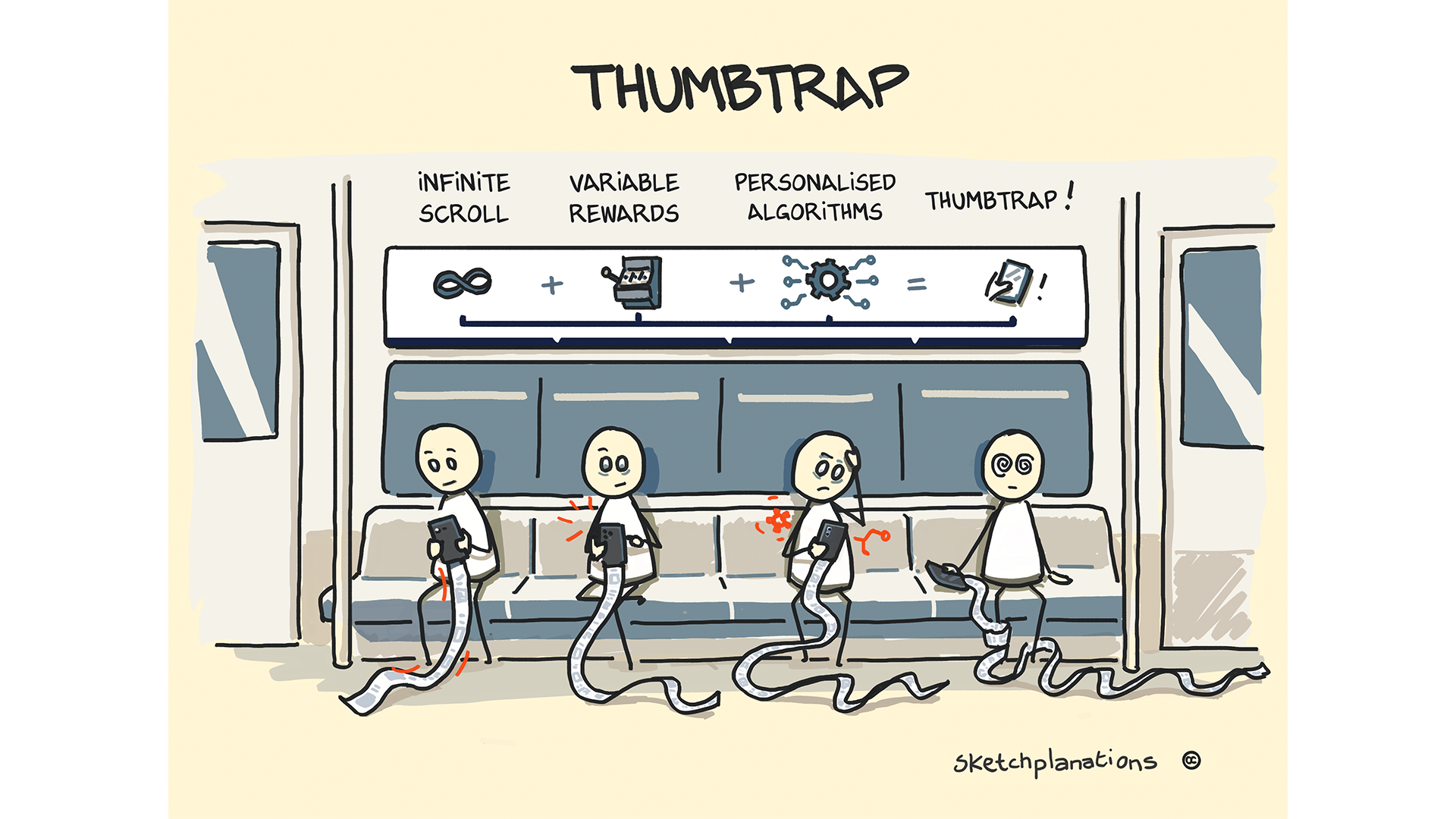
Infographic showing four figures on a subway train in increasing states of compulsive phone scrolling, illustrating the Thumbtrap concept: Infinite Scroll plus Variable Rewards plus Personalised Algorithms equals Thumbtrap. Thumbtrap image by Jono Hey
Thumbtrap is a state where your thumb keeps scrolling even after you’ve decided to stop. As already suggested, Australia’s social media ban may fail because it does not account for thumbtrap’s mechanismsand parental phubbing behaviors may be driven by thumbtrap’s invisible cage.
For Isabelle, being thumbtrapped as Screen Plus App Time is experienced as split attention between physically navigating the mall while also being gripped by the smartphone’s architecture.
Conceptually, thumbtrap describes the state between clinical, diagnostic addiction and thoughtful, deliberate and controlled cell phone use. This is a state or condition most of us are familiar with. The motor action of the thumb (i.e., swipe, scroll) is occurring independent of conscious choice. Hence, decisions of when to stop seem out of our conscious control.
It is also distinct from doomscrolling, which I explore in depth in the first article in this series. Where doomscrolling is driven by content, the pull of negative news, outrage, anxiety, thumbtrap is content agnostic. The mechanism fires regardless of what is on the screen. That is what makes it harder to see, and harder to stop. Isabelle wasn't doomscrolling through the mall. She was thumbtrapped.
Mark Griffiths, Professor of Behavioural Addiction, Nottingham Trent University, in discussing infinite scroll and autoplay, and whether this represents a clinical addiction suggested that it is contestable. He concludes that “For some people it's genuinely addictive. But by my criteria for addiction, very few people would fulfil that.”
Therefore, whether Screen Plus App Time sits as a potential gateway phase (a concept explored in addiction research contexts), is a question worthy of further investigation.
Importantly, thumbtrap is not an incidental smart phone feature. It is the predictable human response to the uniquely designed affordances triggered through the combination of the Screen Plus App. Critically, Screen Plus App Time does not discriminate. All ages are equally vulnerable. Just look around you next time you’re at the mall, the park, on the subway. I have discussed this in depth in the third article in this series “Why parents are hooked on their phones: The unspoken harm of parental phubbing on children – They’re thumbtrapped too”
As outlined in first article in this series, ‘“Thumbtrap”: Smartphone technology that keeps scrolling after you decide to stop”, thumbtrap and the broader Screen Plus App Time construct is derived from three design features, strategically combined, integrated into screens and working in harmony:
When Apps Talk to Each Other, the Thumbtrap Gets Tighter
What Is Inter-App Operability?
Within thumbtrap’s suggested construct, there are clearly specific types or categories of Screen Plus App combinations that are more problematic. Screen Plus App affordances which integrateinter-app operability suggest a multiplier effect and generate even tighter thumbtraps. This elevates the potential risk – no matter what the age.
Definitionally, inter-app operability refers to:
A deliberate design decision, made at the level of developers, platform operators, or both, that enables some separate applications on a smart phone or device to share and exchange information (in real or near-to-real time) and trigger actions in one another, in ways that may serve the interests of developers, platform operators, third-parties or users, or any combination thereof.
It is suggested that through inter-app operability users seem to mysteriously receive a nudge, notification or like (e.g., notifications triggered by another app rather than being spontaneous) when they are using a seemingly unrelated app. Additionally, through inter-app operability apps can create chain-linked loops to extend usage sessions through deepening and tightening thumbtraps, and therefore extending Screen Plus App Time. Furthermore, ‘inter-app operability’ enables deeper data mining, user profiling and highly targeted advertising as apps share data. Combine this with insights from AI, and the prospect for users becomes more concerning. And this is not just for kids and teens, but for all ages, as outlined and argued in an earlier article, “Generation ‘thumbtrapped’: Why the Australian Government’s social media ban for under 16s won’t work”.
Frequently Asked Questions (FAQ)
Q: What did the social media addiction verdict actually find - and why does it matter?
In March 2026, a US jury found the companies negligent, not for the content on their platforms, but for deliberate faults in their platform design. In a 10-to-2 vote, the jury ruled that both companies knew their design was “dangerous” but failed to warn users. The significance for everyday users is not the damages figure. It is that a court has now formally confirmed what many suspected: specific architectural features built into these cell phones and smart phones can cause measurable harm, and the protections platforms previously relied on under Section 230 may no longer automatically apply to companies that deploy those features.
Q: What is wrong with the way screen time is currently defined and measured?
Decades of research have failed to produce a shared, actionable definition of screen time, with the World Health Organisation, academic researchers, and institutional bodies each using incompatible categories. A 2022 academic review described the field as suffering from “poor conceptualisation, non-standardised measures that are predominantly self-report, and research designs that rely on cross-sectional data.” Because the term is used so loosely, and its understanding so vague and personal, when we talk about screen time, we all think of different things. None of them describe being architecturally locked into an infinite scroll loop at midnight with entirely different neurological, behavioural, and emotional implications to watching a family film or actively completing a school task.
Q: What is Screen Plus App Time, and why is it a missing category?
Screen Plus App Time is a specific category of device use time produced when a device’s hardware (i.e., operating system and screen affordances) combine with an apps’ software design and predictable human responses. Unlike passive screen time or intentional browsing, Screen Plus App Time blurs the line between choice and compulsion: it relentlessly calls on attention through nudges and notifications, provides no exit cues once activated, distorts time perception, and subverts user agency in ways that do not discriminate by age. Where buffers, pauses, or timed holds are introduced, this does not reset Screen Plus App Time. The Screen Time component of Screen Plus App Time is anchored in the hardware of the device rather than only in the App Time; hence, Screen Plus App Time.
Q: What is inter-app operability, and how does it make the Thumbtrap tighter?
Inter-app operability is a deliberate design decision that enables separate applications on a smartphone to share data and trigger actions in one another in real or near-real time. In practice, this means a user can receive a notification apparently generated by one app that was actually triggered by data from a different app, thereby creating chain-linked loops that extend usage sessions well beyond what would be expected if a user was on any single platform. When apps are designed to talk to each other in this way, the Thumbtrap effect multiplies: each app-switch that would otherwise signal “time to stop” instead becomes a fresh entry point into a new feed with new rewards, and the designed compulsion of Screen Plus App Time deepens for users of all ages.
From Here, a Choice
What Should Change After the Verdict?
Not all screen time is problematic. But obviously some of it is. And the jury has now confirmed what many of us have long suspected: the presence of a specific, unnamed category of screen time.
That category already has a name. It has had one since the first article in this series. Thumbtrap.
Thumbtrap underpins the user experience of the “Screen Plus App Time Ecosystem”. This is an integrated system in which screens, apps, algorithms and behavioral data operate not as separate tools, but combined through deliberate design decisions, made at the level of developers, platform operators, or both, to share information and trigger actions in one another. These are mechanisms that do not discriminate by age.
Isabelle did pick up her phone to pay. The ecosystem reacted.
Thumbtrap held it all in place. Ten minutes later she surfaced, mid-mall, groceries in hand, wondering where she'd been. The ecosystem had done exactly what it was designed to do. Was this a design fault or intentional? Business Insider reports that “In a 10-to-2 vote, the jury also ruled that the two companies knew their design was "dangerous" but failed to warn the plaintiff.”
As Van Badham wrote in The Guardian:
“Turns out the killer isn't in the building. It is the building.”
If our measures of screen time continue to focus on hours rather than designed compulsion, or even addictive characteristics, we will keep missing the important question. Therefore, a new construct, one built around Screen Plus App Time, one that accounts for how design mechanisms interact and influence human behavior and cognition, is urgently needed.
For Isabelle, and for most of us, the immediate value of naming thumbtrap is not a research agenda. It's a moment of recognition. The next time your thumb is still moving after your mind has already checked out, you now have a word for it. That word creates a gap. And in that gap, there's a choice. You may not always take it. But you'll know it's there.
Postscript
The jury has delivered its verdict. The research has identified the gaps. The mechanism has a name.
What happens next depends partly on whether the concept of Thumbtrap and Screen Plus App Time gains enough traction to change how researchers, platforms and policymakers measure what users are actually experiencing.
If this framing resonates, if you've found yourself in a thumbtrap, or watched someone else navigating that strange gap between deciding to stop and actually stopping, I'd love to hear about it. And if you think Screen Plus App Time describes something that current screen time measures are missing, that conversation matters too.
References note
This article draws on open-access academic literature, institutional reports, and named expert commentary, with links throughout. The Further Reading section provides extensive links to major news coverage of the verdict from outlets across the US, UK, Australia, and India. Additional peer-reviewed literature exists on screen time measurement, platform design, and behavioral addiction, and where accessible, it has been linked directly. Some more recent literature sits behind publisher paywalls and has not been included. However, both the paywalled literature and all open-access sources cited have informed the arguments contained in this article, together with the development of the thumbtrap concept and construct.
This Article Is Part of the Thumbtrap Series
Thumbtrap is a developing concept examining the design mechanisms behind compulsive phone scrolling. Read the full series:
"Thumbtrap": The smartphone design that keeps your thumb scrolling after you decide to stop
Generation 'Thumbtrapped': Why the Australian Government's Social Media Ban for Under 16s Won't Work
Social Media Addiction Verdict Redefines Screen Time: Thumbtrap in Action
Why You Can't Stop Scrolling: 15 Conditions That Define Thumbtrap
Further reading
ABC America:
ABC Australia:
Meta and Google found liable in landmark social media addiction lawsuit
BBC:
A game-changing moment for social media' - what next for big tech after landmark addiction verdict?
CNN:
The Conversation:
The Guardian:
Meta and Google trial: are infinite scroll and autoplay creating addicts
The Guardian view on social media in the dock: tech bros move fast – society is trying to catch up
India Today
Google, Meta found liable for $3 million in damages in online addiction suit
India Express
Meta, YouTube found liable for ‘addiction’ in the US. Could it have implications in India?
NBC America
Jury finds Meta and YouTube negligent in landmark lawsuit on social media safety
New York Times
Meta and YouTube Found Negligent in Landmark Social Media Addiction Trial
Sydney Morning Herald
Meta and Google found liable in landmark social media addiction trial
This Article Is Part of the Thumbtrap Series
Thumbtrap is a developing concept examining the design mechanisms behind compulsive phone scrolling. Read the full series:
"Thumbtrap": The smartphone design that keeps your thumb scrolling after you decide to stop
Generation 'Thumbtrapped': Why the Australian Government's Social Media Ban for Under 16s Won't Work
Social Media Addiction Verdict Redefines Screen Time: Thumbtrap in Action
Why You Can't Stop Scrolling: 15 Conditions That Define Thumbtrap
Why Parents Are Hooked On Their Phones: The Unspoken Harm Of Parental Phubbing On Children – They’re Thumbtrapped Too
It All Begins Here
This article is part of the Thumbtrap series.
Thumbtrap.org is the canonical reference home for ongoing interdisciplinary research into human responses to the design mechanisms that produce compulsive scrolling: a state where your thumb keeps moving after you've decided to stop.
Key Insights
Research shows that between 36%, 47% and 74% of parents struggle with the same phone behaviors they’re trying to prevent in their children.
Research shows that between 51% and 46% of teens report that, when talking to their parents, they are distracted by their phones, yet only 31% of parents acknowledge becoming distracted.
Australia’s social media ban has been suggested to be about more than teens’ social media use. It’s about “the role of phones in our lives, it is about the role of social media in our lives, it is about how families interact”.
Summary
Understanding thumbtrap’s architecture reveals why, even when parents want to stop scrolling they can’t. Additionally, why the social media ban places an impossible burden on them. When the legislation was being formulated or eventually enacted, this pending, unspoken burden on parents was never discussed. As Sean Kelly suggests, the social media ban is “about the way people live their lives; it is about children, but it is about all of us.”
So, with access to social media theoretically removed and denied to children and teens, they have a front-row seat, observing just how trapped their parents and siblings are. If parents are encountering challenges enforcing boundaries around social media use for their kids, it is not due to negligence or permissiveness. Far from it. They may be failing because they’re encountering the same behavioral engineering their children face. Often, without realizing it
Parental Phubbing In-Action: A Vignette
It’s a family situation familiar to many of us. Dad’s at the kitchen table. Scrolling. Hoping for an escape after a hell of a day at the office. Mum’s checking emails and LinkedIn. Their 18-year-old son is app-hopping, slumped on the sofa, his expressions cycling through grief, humor, surprise, boredom, shock. For all of them, the same pattern seems evident: swipe, scroll, swipe. Tap, type. Repeat.
Watching on is their 14-year-old daughter. Her smartphone’s still active, but most of her social media apps are gone. “It’s the law now”, her parents say. “It’s Australia’s social media ban for under-16s.” After three months, she’s adjusting. But she looks around and wonders. The family’s all here, but somehow, they’re not. Trapped in the same endless loop? Under a spell?
She tries to break the spell. “Hey Dad, how was your day?” Silence. “Dad!?” “I’m busy, sweetheart. Can’t this wait?” He didn’t even listen to what she asked. Swipe, scroll, swipe. Tap, type. Repeat.
She moves to Mum, confident her history-buff mother will be interested. “Mum, school was so cool today. We learnt about the Romans and aqueducts.” Without looking up: “Uh-huh.” Swipe, scroll, swipe.
Her brother? Not worth the effort. He can swipe and scroll for hours without saying a word. Maybe a random, “you’ve gotta see this…!” but not much else.
So, she sits there watching. Then it dawns to her. There’s a word for this.
Phubbing, generally understood, is the behavior of snubbing someone in favor of smartphone use during face-to-face interactions.
She realizes “The whole family is phubbing me! They are all more interested in their devices than they are in me”. A very painful awakening indeed.
But here’s what makes this family’s dynamic particularly revealing: the very ban designed to protect children may be undermined by the adults meant to enforce it.
This scenario plays out in thousands of Australian homes since December 10, 2025, when Australia became the first nation to ban social media for children under 16. While 77% of Australians expressed support for the measure, 75% of teens said they’d continue using social media. Early reports confirm widespread circumvention through VPNs and fake accounts
The Elephant In The Living Room
Parents Are Scrolling Too: The Data That Makes Parents Uncomfortable
Parents are not ignorant of phone snubbing children. Parents report awareness that overuse of their smartphones use can negatively impact children’s physical and mental wellbeing. Simultaneously parents can struggle with their smartphone overuse. Research finds that many parents can average between 4 hours and 6 hours on their smartphone, with between 36%, 47% and 74% of parents reporting that they spend too much time on their smartphones. Consequently, many parents find monitoring and managing their child’s smartphone use difficult and unsuccessful.
This is the same behavior they’re now tasked with monitoring in their children. Clearly, for many parents, much of this time on their smartphone will be in ‘family time’.
Parents are therefore, knowingly or unknowingly, actively phubbing their own children. Surveys support this proposition, with between 46 and 51% of teens reporting that, their parents are distracted by their phones when they are talking to them. Parents distracted by phones, and phone-ignoring behavior is not a new phenomenon. It does continue, however, to remain a pressing an issue. Parents know it’s an issue, particularly around reported feelings of guilt.
Phone distraction is causing measurable and real harms to their children by their own choices and actions.
Parents clearly experience a tension between numerous competing screen time ideas:
Excessive smartphone use can harm their children’s mental health and emotional development
Their own smartphone use can be compounding their child’s mental and emotional health
Is their behavior modelling appropriate reciprocal social interactions
Are they modelling appropriate use of smartphones around their children
When between 46 and 51% of teens report that, when talking to their parents, they are distracted by their phones and only 31% of parents acknowledge becoming regularly distracted, denial may be at play. Why? Because there is clearly an awareness gap. Research has supported this finding, with observations of parental smartphone use and their self-reports being inconsistent.
All this data and research suggests that parents may be, at a surface level of attention, aware they are phone snubbing their children. Yet, they remain unable to recalibrate their own use considerate of their children.
Australia’s Social Media Ban: The Unspoken Assumption About Parents
What The Ban Requires
By enacting the social media ban, the Australian government tacitly shifted the enforcement of the ban from platforms to families. This shift does not undermine or undervalue the concerted efforts made by designated social media companies to remove under-age accounts from their platforms. Australia’s ABC reports that over 4.7 million social media accounts have been closed, which is an outstanding effort, and shows commitment by the tech platforms. Additionally other sites, such as Roblox, currently outside the ban, are coming under increased scrutiny.
However, in discussing his latest Quarterly Essay, The Good Fight What Does Labor Stand For?on ABC Radio National, Sean Kelly, illuminates the suppressed subtext contained in Australia’s social media ban.
In his analysis, the social media ban is not only targeted at children and teens, as widely suggested, but more broadly, social change. As Kelly comments, the social media ban represents a “policy intervention” aimed at a society-wide “moral vision of the world”, which gives voice about “how life should be lived”.
Kelly states that the social media ban is about “the role of phones in our lives, it is about the role of social media in our lives, it is about how families interact”. Therefore, as Kelly contends, “it’s it about the way people live their lives; it is about children, but it is about all of us.” For many parents, and the wider community, making the implicit, explicit is a jolt, and an uncomfortable awakening for many. For others, it may explain parent-facilitated circumvention of the social media ban.
Since teen-motivated and parent-facilitated circumvention is happening, as outlined in article 2 of the series, Generation ‘thumbtrapped’: Why the Australian Government’s social media ban for under 16s won’t work, four parental capacities were required should the government wish the ban to be effective.
However, surveys and research consistently report that parents may lack the very capacities that the ban requires, such as:
Recognize their own problematic patterns that they systematically underestimate
Model behaviors they don’t practice
Enforce boundaries they can’t maintain themselves
Supervise effectively when teens possess greater digital literacy
Further Reading
There are numerous, open access academic articles that provide extensive depth and discussion about parents’ use of smartphones. For those interested in a deeper dive, I can suggest the following journal articles:
Why Parents Can’t Stop Scrolling
Importantly, the answer lies not in parental unwillingness, incompetence or hypocrisy, for parents are generally committed and focused on their own and their children’s overall wellbeing. However, powerful design mechanisms that leverage universal human vulnerabilities, no matter what our age are what we are up against.
Before naming it, it is worth providing clarity. Thumbtrap is not addiction, not in the clinical, diagnostic sense. It also does not describe incidental use of a smartphone, such as a deliberate check, a conscious scroll, where once complete, the phone set down without a second thought.
Thumbtrap sits between those two states. For most of us, this is the space we currently occupy. Thumb actions are somehow occurring without conscious choice, yet not at a pathological level. However, we no longer feel fully in control of when we stop. For some users, it could be considered a potential ‘gateway phase’, as has been discussed in research the context of sexting.. And because thumbtrap emerges as a response to the product’s design, it does not discriminate. Age, willpower, and love for one’s children offer no reliable protection.
This is what I call Thumbtrap.
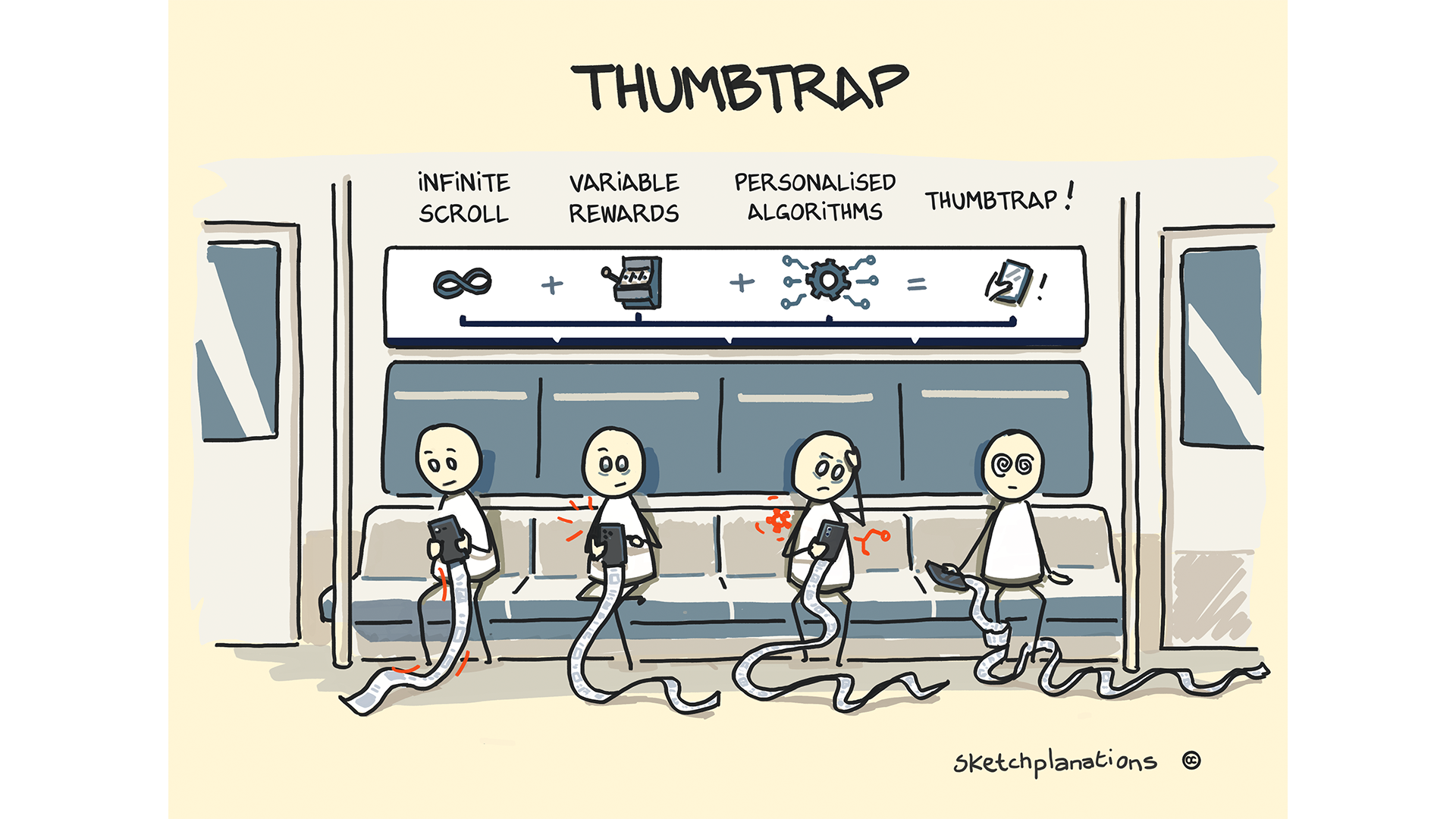
Infographic showing four figures on a subway train in increasing states of compulsive phone scrolling, illustrating the Thumbtrap concept: Infinite Scroll plus Variable Rewards plus Personalised Algorithms equals Thumbtrap. Thumbtrap image by Jono Hey
Understanding thumbtrap’s architecture exposes why the social media ban places an unexpected onus on them. Now that children and teens are legally unshackled from their social media accounts, they can see how trapped their parents, adult friends and siblings are.
Why Traditional Parenting Boundaries No Longer Work:
What Is Thumbtrap?
Thumbtrap is a state where your thumb keeps scrolling even after you’ve decided to stop.
Thumbtrap characteristics are:
Your thumb scrolls automatically without conscious choice
Time distortion (20 minutes feels like 5)
Cognitive-behavior gap (you decided you want to stop, but don’t seem to be able to)
Content becomes irrelevant (maybe not even enjoying it)
Dopamine scrolling (the brain’s neurotransmitter that reinforces thumb action)
Thumbtrap is fundamentally a cognitive-behavior gap, a learned and reinforced “behavioral loop” that overpowers thinking, “okay, that’s enough” and realizing twenty minutes later you’re still swiping. Swipe, scroll, swipe. Tap, type. Repeat. Your conscious mind has checked out, but your thumb never received the stop signal. I explored and elaborated on the design mechanism behind thumbtrap in article 1 of this series: “Thumbtrap”: Smartphone technology that keeps scrolling after you decide to stop.
To understand why parents can’t serve as effective gatekeepers, seeing how thumbtrap operates in their lives is important, specifically in those incidental parenting moments. When parents engage in phone snubbing, they’re displaying thumbtrap behavior toward their children.
What Does Thumbtrap Look Like In Real Parenting Moments? Three vignettes.
Bedtime Phubbing Thumbtrap
It’s 8:30pm. The house is finally quiet. His son is upstairs still scrolling. He reminds himself: tomorrow night, he’ll enforce the 10:00pm phone rule for his son. His 14-year-old daughter’s next to him on the sofa, reading. The thought of, “well what else can she do now all her social media accounts have gone?” passes through his consciousness. It does not land.
He settles back onto the couch, TV on, phone in hand. “Just five minutes on LinkedIn to unwind” he tells himself. Tap. He’s in! “Oh, someone from my old company’s got promoted.” His mind drifts as his thumb swipes and scrolls. His mind’s now miles away thinking about old colleagues. He’s even further away from his daughter sitting next to him. The evening’s slowly slipping away. He looks over. His daughter has gone. “When did she leave?”
As this thumb automatically continues to swipe, her voice echoes in the silence “How was your day, Dad?” He can’t even remember what he said. One more swipe. He knows he should stop. A video of a traffic accident. Wild speculation. Then to YouTube via a link. He finally glances up. It’s 10:15pm. His heart sinks. Tomorrow will be different.
This is phubbing, and research links it to children’s behavioral problems and feelings of rejection.
Micro-break Phubbing Thumbtrap
It’s 4:15pm. The end of the workday has arrived. Mom’s just finished back-to-back Zoom meetings. Her 14-year-old daughter is at the kitchen table, textbook open, working on a history assignment about Roman engineering. Mom had said she’d help. She’d promised. “Just give me five minutes to unwind” she’d said.
With that she taps in. Work email first. Nothing urgent, but she scans anyway. “Just a quick check of Instagram won’t harm” she reassures herself. Renovation photos. Impressive kitchens. Makeovers galore. “Amazing!” Swipe, scroll, swipe. BUZZ! A notification from her school parents’ group. Seventeen comments. “Mom?” She doesn’t hear. She’s mentally drafting a response. “Mom, can you help me understand aqueducts?” “Uh-huh.” She doesn’t look up. Swipe, scroll, swipe. Her daughter waits. Thirty seconds. A minute. Swipe, scroll, swipe. She returns to her textbook, alone. Again. Mom finally glances up. 4:37pm. Twenty-two minutes have vanished. Her daughter’s hunched over her book. Resigned. “You okay with your homework, honey?” she asks, guilt creeping in. Her daughter doesn’t look up. Doesn’t need to. After three months, she’s learned.
Her phone buzzes. Another notification. Her thumb moves instinctively. Tomorrow. Tomorrow she’ll be more present. Tomorrow she’ll actually help.
Social Phubbing Thumbtrap
Sunday, 11:00am. The family’s out for brunch. “Family time.” Mom thought it’d be a good idea. Their 14-year-old daughter sits between her parents and 18-year-old brother, surrounded by the buzz of conversation from other tables. Laughter. Stories being shared. Families talking. Others, eerily silent. Just like theirs. Everyone’s on their own devices.
Dad’s scrolling through the news. “Just checking something quickly.” Mom’s on Instagram, swiping and scrolling through friends’ weekend photos. Their daughter sits between them, hands in her lap. Her brother has his headphones in. No idea what he’s listening to, watching, or swiping past. No social media apps for the 14-year-old. Nothing to do. But wait. And watch.
She tries: “The pancakes here are supposed to be really good.” “Mm-hmm,” Dad murmurs, not looking up. She waits. Thirty seconds. A minute. The silence grows heavier. She looks around. People on the other tables seem engaged, connected, chatting, laughing. She feels exposed. Alone at a table with her family right there. Mom glances up briefly. “Sorry, honey, what did you say?” But before her daughter can answer, a notification pulls her back down. Swipe, scroll, swipe. The waiter arrives. “Ready to order?” Dad looks up, dazed. “Oh, sorry, we haven’t looked at the menu yet.” They’ve been sitting there for eighteen minutes. His daughter says nothing. She’s learned what “family time” means now.
The Pattern: What All Three Scenarios Reveal
It is important to identify what these three vignettes share: not a lack of parental love or intention, but the inability to turn intention into actions. Wherever and whenever opportunities for connections can be formed, the thumb keeps moving long after the mind says stop. Eighteen minutes. Twenty-two minutes. Nearly two hours. Time stops, yet disappears. Each family member, except the 14-year-old girl, inhabits an “everlasting present” because they are trapped. Thumbtrapped in an environment built on:
Infinite scroll provides the structure.
Intermittent rewards / variable rewards schedules provide the incentive.
Personalized algorithms through datamining provides the precision
Thumbtrap doesn’t feel like a trap when you’re constantly switching the scenery. Swipe, scroll, swipe. Tap, type. Repeat
For the 14-year-old girl, the ban is meant to protect her. On many fronts, it is operating as planned. Interestingly, it’s also given her a front-row seat to her family’s collective absence. And with this heightened awareness, she’s the one whose required to deal with consequences of parental phubbing: isolation, broken promises, normalized absence.
This Is Why The Social Media Ban’s Enforcement Burden Is Impossible
In synthesizing the literature and surveys, Australia social media ban enforcement requirements, are unreasonable because:
1. The policy assumes parents distracted by phones will reset and be able to refrain from phone snubbing. The research highlights numerous challenges that parents need to overcome.
2. These ‘thumbtrapped’, ‘screen time parents’ will be required to model healthy boundaries, supervise effectively, and enforce rules they’ve set. The research suggests otherwise.
3. The policy assumes thumbtrap discriminates by age. That when a child turns sixteen, they will possess the neurological, cognitive emotional and behavioral capacities to manage and overcome the mechanisms inherent in thumbtrap (i.e., infinite scroll + variable reward schedules + algorithmic precision). This is most unlikely and individual research is quite conclusive.
4. The policy assumes that teens will not seek the circumvent the social media ban, either with or without parental tacit or explicit approval. The research reports that circumvention is happening.
Frequently Asked Questions (FAQ)
Q: What is parental phubbing, and how does it harm children?
Parental phubbing is the behaviour of snubbing a child or teenager in favour of smartphone use during face-to-face interactions, such as scrolling at the dinner table, not looking up when spoken to, or being physically present but mentally absent. Research links it directly to children's feelings of rejection and behavioural problems. Between 46% and 51% of teens report that their parents are distracted by their phones during conversations, yet only 31% of parents acknowledge becoming regularly distracted. This is a significant awareness gap that some research describes as a form of denial.
Q: Why do parents find it so hard to put their phones down in front of their children?
The answer lies not in parental negligence or hypocrisy, but in the same Thumbtrap architecture that affects everyone: infinite scroll removes natural stopping points, variable reward schedules keep the thumb moving in anticipation of the next hit, and personalised algorithms consistently show content most likely to hold that individual's attention. Thumbtrap does not discriminate by age, love for one's children, or strength of willpower. Research finds many parents average between four and six hours daily on their smartphones, with between 36% and 74% reporting they spend too much time on their phones. Yet, they find themselves unable to change the behaviour.
Q: What impossible burden does Australia's social media ban place on parents?
The ban tacitly shifted enforcement responsibility from platforms to families. But the research suggests parents lack the very capacities the ban requires. They are expected to model healthy boundaries they find difficult to practice, supervise effectively when their teens often possess greater digital literacy, enforce rules they cannot maintain themselves, and resist the same Thumbtrap mechanisms their children face. The policy assumes Thumbtrap discriminates by age; that turning 16 confers the neurological ability to resist infinite scroll and variable rewards. But the prefrontal cortex, responsible for impulse control, does not fully mature until approximately age 25.
Q: What does parental phubbing look like in everyday family moments — and what is its real cost?
This article outlines three scenarios in detail: the bedtime Thumbtrap, where a father intending five minutes on LinkedIn looks up to find nearly two hours have passed and his daughter has gone to bed unnoticed; the micro-break Thumbtrap, where a mother who promised to help with homework loses twenty-two minutes to Instagram while her daughter waits and then quietly gives up; and the social Thumbtrap, where an entire family sits at a Sunday brunch in collective silence, each on their own device, while their 14-year-old daughter, the one the ban was designed to protect, sits with nothing to do but watch on. The real cost in all three is not screen time lost, but connection lost: the child learning that “family time” means managed absence, broken promises, and the quiet normalization of being present, but absent.
Conclusion
While thumbtrap affects everyone, parents face a unique “double bind” with their screen time: they’re expected to enforce boundaries they themselves may struggle to monitor and change.
This conundrum places parents in an invidious position. If, as Sean Kelly outlines, the social media ban is fundamentally about “the role of phones in our lives, it is about the role of social media in our lives, it is about how families interact”, then its impact is something that all of us need to be prepared for. This precise topic will be discussed fully in a following article the Thumbtrap series.
Postscript: Does “Thumbtrap” Fit Your Experience?
I’m curious whether this word resonates with you.
Have you had that experience of your thumb scrolling on after your mind has already checked out? That moment where you realize you wanted to stop, but found it impossible?
If thumbtrap fits something you’ve seen in others, experienced yourself, or are currently struggling with, I’d love to hear about it. How do you notice it happening? What does it feel like? And have you found anything, like naming it, friction, usage rules, app blockers or something else entirely helps you break the cycle, escape the loop and exit the thumbtrap?
References Note:
I have aimed to include references (hyperlinks) that are open-sourced so that readers can check concepts and constructs for themselves. Other additional and recent literature is available, but as this sits behind publisher paywalls, I have not included.
This Article Is Part of the Thumbtrap Series
Thumbtrap is a developing concept examining the design mechanisms behind compulsive phone scrolling. Read the full series:
"Thumbtrap": The smartphone design that keeps your thumb scrolling after you decide to stop
Generation 'Thumbtrapped': Why the Australian Government's Social Media Ban for Under 16s Won't Work
Social Media Addiction Verdict Redefines Screen Time: Thumbtrap in Action
Why You Can't Stop Scrolling: 15 Conditions That Define Thumbtrap
Generation ‘Thumbtrapped’: Why The Australian Government’s Social Media Ban For Under 16s Won’t Work
It All Begins Here
This article is part of the Thumbtrap series.
Thumbtrap.org is the canonical reference home for ongoing interdisciplinary research into human responses to the design mechanisms that produce compulsive scrolling: a state where your thumb keeps moving after you've decided to stop.
Updated April 2026:
See “Australian High Court Challenge & Revised Regulations” for important new information on how the government has expanded the scope of the regulations to incorporate Thumbtrap mechanisms
What Parents Can Do.
On December 10, 2025, Australia became the first nation in the world to ban social media for children under 16. The government officials characterized the ban as a significant step forward and an important protective measure. For the 77% of Australians who supported the ban, they felt vindicated.
But the surveys also revealed:
75% of affected teenagers said they’d continue using social media anyway.
72% believed the ban wouldn’t work.
Many Teens Cannot And Will Not Quit Social Media
For many adults, social media is like a hub where we can generate content, share personal messages, information, ideas, photos, and videos. We can join communities of interest, follow what our friends are up to, comment on topics and engage through, for example, likes, shares, reactions, and retweets. We can tap in, check out what’s happening, make a comment, scroll through the news.
Social media for many of us is the glue that keeps us feeling connected, whether we’re at home, on the move or between tasks. And there's a potential world of followers, some we know, many we don't who are just a 'join' away. It’s always on and on-demand.
Now place your child or teen in this scenario.
Remember that for many teenagers, forming their identities and peer acceptance is paramount. For some teens, their entire social world lives there. Consequently, for teenagers navigating identity and peer acceptance, and for whom being online represents a major part of their life, the attraction and pull of social media are exponentially stronger than for adults.
Will they willingly quit?
Would you?
Subversion as a natural response: Lost connections
As kids and teens develop, this inherently requires peer connection. We all remember that. It’s powerful and undeniable. For many teens, social media serves these fundamental developmental needs, that for us were developed off-line, in person, within possibly very limited geographical boundaries.
For teens today, the social media ban creates tension between the ban's protective intent and biologically-driven social needs. So, rather than defiance or rebellion, some teens are expressing their feelings and are calling on adults to understand.
Research has reported that adolescents experience “heightened sensitivity to social feedback and rewards”, with social media potentially activating “the biological systems that are responsible for adolescents' heightened sensitivity to social feedback and rewards”. Other research has suggested that, after using social media to interact with peers, adolescents “may feel more connected and crave fewer social connections and novel stimuli”. Therefore, for many, when denied these interactions, teens experience increased social craving, feelings of disconnection and desire for novelty.
This creates a striking paradox: Research from headspace found that 50% of young people want to disconnect from social media but feel they can't because of fear of missing out. Even when teens recognize the problem, their developmental biology and social architecture make escape nearly impossible.
The deep social connections that many teens feel on social media can provide stability and belonging and serves as their anchor. Social media can provide a lifeline to communities and friends, particularly for those from marginalized communities.
UPDATE: Australian High Court Challenge & Revised Regulations
As reported originally on Australia’s ABC on November 26, 2025 and The Guardian on November 27, 2025 and recently updated on April 11, 2026, two 15-year-old teenagers, with the support of NSW Libertarian MP John Ruddick, and as part of a wider Digital Rights case, are appealing to the High Court of Australia based on:
“the grounds that Australians have a constitutional implied right to freedom of political communication, and the ban will prevent teens under 16 from engaging in political communication on social media platforms.”
There are numerous technicalities around the appeal, but as stated by Prof Sarah Joseph of Griffith University’s law school to Josh Taylor, should the law be proved to be ineffective (i.e., not effective in achieving it purpose of blocking under 16s from accessing social media accounts), then the law “cannot go very far in achieving its purposes, and therefore cannot be a proportionate means of achieving those purposes”.
Interestingly, and whether in response to this, as reported by Sky News on March 26, 2026, changes were made to the regulations that are being considered by the High Court challenge. Anika Wells, the minister responsible updated the rules registered to include:
1. Algorithms which are “designed to be addictive and provide constant dopamine hits by providing highly personalised material based on information associated with a young person’s account”
AND / OR
2. Infinite scroll which is “designed to keep young people engaged for as long as possible by showing new content as you scroll, swipe or flick with no end point”
3. Feedback feature such as “the number of ‘likes’ or ‘upvotes’ a user has received”
4. Disappearing content which is “designed to create urgency so young people check apps constantly out of fear of missing out”
Anika Wells concluded by saying,
“We’re shining a light on these harmful and addictive features being used to target young Australians.”
So, when the social media ban for under-16s was initially proposed, the Australian Government focused on content: cyberbullying, predators, harmful images, toxic comparisons. The Australian government’s framing emphasized these dangers. These harms are real and they should never be underestimated. They are damaging.
It seems that as a US jury has recently examined the architecture behind our screens and found it caused harm, the Australian government has expanded the scope of the laws, because the verdict has exposed a fundamental flaw in how screen time is defined, measured, and understood, for users of all ages.
This finding and what it means in the context of Australia’s Social Media Ban is explored in depth in a follow up article, Social Media Addiction Verdict Redefines Screen Time
Consequently, it’s clear that the revised and expanded scope of regulations, both recognise and specify, there are other, deeper, and one might suggest, more insidious harms lurking, not just for teens, but for all users.

Infographic showing four figures on a subway train in increasing states of compulsive phone scrolling, illustrating the Thumbtrap concept: Infinite Scroll plus Variable Rewards plus Personalised Algorithms equals Thumbtrap. Thumbtrap image by Jono Hey
Thumbtrap
This deeper problem is what I call Thumbtrap. Thumbtrap is a state where your thumb keeps scrolling even after you’ve decided to stop. It’s a “behavioral loop”. It’s that strange gap between thinking, “okay, that’s enough” and realizing twenty minutes later that you’re still swiping. Tap in. Swipe, scroll, swipe scroll. Your conscious mind has checked out, but your thumb never received the stop signal.
Thumbtrap primarily operates through three design features combined and working in unison:
Intermittent rewards / variable reward schedules
Personalized algorithms through data mining
We are all vulnerable to being thumbtrapped.
Thumbtrap doesn’t care if you’re 15 or 17 or 57.
Thumbtrap exploits the same human characteristics shared by all of us.
Starting The Social Media Ban At Age 16.
Why 16 And Not 15 Or 17?
And this is the point we find so hard explaining. And our kids know it!
Starting the social media ban at age 16 is arbitrary. The prefrontal cortex, the area of the brain responsible for impulse control and resisting addictive patterns, doesn't fully mature until approximately age 25. Therefore, a 16-year-old’s brain is fundamentally no more equipped to resist thumbtrap mechanisms (infinite scroll + reward schedules + algorithmic profiles) than a 15-year-old’s brain or a 24-year old’s brain
Additionally, the brain's dopamine system, which makes variable rewards (likes, comments, shares) addictive, peaks during mid-adolescence (ages 14–17). Variable reward schedules therefore are more addictive to teenagers than to adults. But they are still very persuasive to us!
These two neurological factors are important for parents to understand.
Why Is This Important For Parents To Understand?
Because when your 16-year-old gains legal access to Instagram or TikTok, they’ll be encountering the identical thumbtrap architecture that was too harmful for them at 15. Now, with reduced parental authority (“it’s legal now”) and possibly years of pent-up social pressure to rejoin their networks (if they have not already) the dangers multiply.
Given that teens will find ways around the ban, what can parents actually do?
Circumvention is already happening
Under 16s are circumventing the law because, kids cannot quit social media without losing their digital social network. Children who've grown up with devices from infancy, with iPads, tablets and smartphones in their little hands, with the miniature thumbs and fingers pushing and swiping; the colors, the bells, the jingles, the rewards the gamification, find the mandated disconnection akin to adults’ being unreasonable. And maybe since we put devices in the hands from infancy, they have a point.
Unsurprisingly, reports from the ban's first day and subsequent weeks confirm what the surveys predicted. Media outlets including ABC News, CNBC, and TIME documented that teenagers are accessing banned platforms through VPNs, fake birthdates, manipulating facial recognition systems, and using parent or sibling accounts to bypass age verification.
What Parents Can Do
The ban addresses regulatory factors. Parents are expected to address everything else.
Here are four categories of factors that determine whether your child develops healthy or harmful social media relationships:
Design-based
Platform architecture employs features that leverage human psychology. The ban doesn't change the design.
Current status: Infinite scroll, variable rewards, algorithmic feeds remain fully operational; no platform changes required by law.
Why Ban Alone Is Insufficient: These features hijack attention regardless of user age; 16-year-olds face identical architecture as adults; content moderation doesn’t address mechanism harm.
Parental Leverage Points: Try app blockers; enable and track screen time limits; choose chronological feeds where available; disable autoplay and notifications
User-based (under 16)
Teenage brain development makes them especially vulnerable to Thumbtrap mechanisms. And this vulnerability extends well beyond age 16, so it affects us all.
Current status: 75% intend to circumvent; high digital literacy and social networks facilitate and enable workarounds; withdrawal symptoms drive access attempts; peer pressure
Why Ban Alone Is Insufficient: Teenage prefrontal cortex immature (until age 25); dopamine system peaks 14–17; social network lock-in creates impossible choice between parental compliance and social connection
Parental Leverage Points: Teach metacognition (awareness of thumbtrap); name the phenomenon together; acknowledge difficulty for parents and kids; focus on behavior patterns not moral failures.
Supervision-based
As parents, we should strive to encourage and enforce the ban. However, motivated, ingenious and determined teens with digital literacy can easily find workarounds.
Current status: Parents report feeling empowered by ban but 67–74% doubt it will work, with 68% believing their children will get around the ban; enforcement burden falls on families at home
Why Ban Alone Is Insufficient: Supervision alone may create tense relationships; tech-savvy teens outpace parental knowledge; borrowed devices may bypass home controls
Parental Leverage Points: Create device-free zones (not just times); charge phones outside bedrooms; use physical friction not just rules; focus on environmental design.
Modeling-based (parents, siblings, peers, social networks)
Our teens will copy what they see, not listen to what they're told. So, parental and sibling behavior matters more than rules.
Current status: Research finds that many parents average between 4 hours and 6 hours on their smartphone; older siblings model unrestricted use; peer networks entirely digital; quitting may mean social isolation
Why Ban Alone Is Insufficient: Kids learn behavior by observation more than instruction; parental hypocrisy (“do as I say not as I do”) undermines authority; social networks could be the primary barrier to quitting
Parental Leverage Points: Parents should model healthy usage; older siblings should be aware of their influence; create family-wide boundaries (not just under 16 focused); acknowledge parents are thumbtrapped too; model and build offline social interests
Five practical strategies for parents
1. Name the thumbtrap with your teen
Remove the shame. Acknowledge that powerful design forces are at work. Generate a shared language.
The moment you identify you’re in a thumbtrap, you create a tiny space between the behavior and the person.
It’s not “you’re addicted” or “you lack self-control.” It’s “you’re experiencing a thumbtrap right now.”
That means the powerful design patterns, such as dark patterns are at play.
Try this: Next time you notice you or your child scrolling with that glazed look, say “Hey, are you thumbtrapped right now?” Not judgmentally. Curiously. You might be surprised. If they have the language and understanding, they often know they are.
The naming creates a microsecond of awareness. In that space, choice becomes possible.
2. Model healthy usage (parents are thumbtrapped too)
Here’s the uncomfortable truth: we’re probably thumbtrapped too. Your teen watches you scroll at breakfast, check your phone during conversations, and reach for your device the moment you’re unoccupied. These are all thumbtrap behaviors. Tell your kids about your own struggles:
“I was thumbtrapped for 20 minutes this morning. I’m going to put my phone in the other room for an hour.”
If we want our teens to develop healthy boundaries, we should demonstrate them ourselves. We need to show them what appropriate use looks like.
This isn’t about perfection.
It’s about honesty.
When we can acknowledge our own challenges; our insecurities and actions, we remove the potential for hypocrisy (kids spot this really well) that undermines our hopes and intentions and eventually, our authority.
3. Create device-free zones and times
Generally, rules without environmental design tend not to succeed. Saying to your child, “Don’t use your phone at dinner” for example, can be seen as confrontational. Also, it requires constant willpower. Instead, have an agreed family rule, such as, “Phones on silent and charge in the kitchen during dinner”. This requires some willpower, but the phone isn’t there, in front of their and your face to resist.
4. Teach metacognition through questioning
Help your teen develop awareness of being thumbtrapped by asking three questions. Firstly, you’re trying to help your teen see the behavior, the pattern. Then name the it; (thumbtrap) then exit the behavior (tap out).
The behavior you’re trying to help them see is thumbtrap.
a. “Did you decide when you were going to stop?” (Intentionality)
Help them identify the moment they thought “okay, that’s enough.”
b. “When did you actually stop?” (Time Perception)
Help them notice the gap between decision and action.
c. “What made it hard to stop?” (Pattern Recognition)
Help them recognize the design features of a thumbtrap: “I kept seeing things I wanted to check,” “the next video autoplayed,” “I got a notification right when I was about to close the app.”
5.Don’t rely on the ban alone
Assume your teen will have access or gain access through friends regardless of the law
Maybe they’ll circumvent. Maybe they’ll wait until 16. Either way, the thumbtrap architecture will be there waiting for them every time they use their device.
This means:
Teaching them how thumbtraps work (infinite scroll + variable rewards + algorithms)
Helping them notice when they’re trapped
Providing them with exit (tap out) strategies
Creating offline alternatives for social connection
Acknowledging that this is genuinely difficult (for adults too)
The ban buys time. Use that time to build awareness, skills, and alternatives.
The Role Of Older Siblings And Peer Networks
If you have multiple children, creating different rules for different ages can be fraught. Your 17-year-old’s unrestricted access teaches your 14-year-old that the rules and boundaries are arbitrary and temporary. They’re sharing content. They’re modeling that “it’s fine.”
They’re maybe actually modeling thumbtrapped behavior.
So, family-wide boundaries (device-free meals, bedrooms, morning/evening hours) may help. Everyone follows the same rules. The older sibling doesn’t feel singled out. The younger sibling doesn’t feel unfairly restricted.
And critically, the older sibling models healthy behavior instead of undermining it.
Similarly, your teen’s friend group is their digital social network. If some of their friends are circumventing the ban or counting down to 16, your teen experiences the ban as possibly hurtful, unfair and adult enforced social isolation, not protection.
This is where parental coordination can help. Talk to other parents. Create shared boundaries within friend groups. Help your teens build offline social opportunities, such as sports, clubs, volunteering, part-time work. The goal isn’t to eliminate digital connection. It’s to ensure it’s not the only connection.
Frequently Asked Questions (FAQ)
Q: Why won't Australia's social media ban for under 16s be enough on its own?
Australia's ban, introduced on December 10, 2025, addresses access to social media platforms, but it does not address the underlying design architecture and mechanisms that creates compulsive scrolling in the first place. Infinite scroll, variable reward schedules, and personalised algorithms remain fully operational on every platform, still active the moment a teenager turns 16 or circumvents the ban through a VPN, a fake birthdate, or a sibling's account. The ban buys time; it does not dismantle the Thumbtrap.
Q: Why is 16 an arbitrary age to start the social media ban?
The prefrontal cortex; that the part of the brain responsible for impulse control and resisting addictive pattern, does not fully mature until approximately age 25. A 16-year-old's brain is neurologically no better equipped to resist Thumbtrap mechanisms than a 15-year-old's brain or a 24-year-old's brain or an adult’s brain. Additionally, the dopamine system that makes variable rewards, such as likes, comments, shares most addictive peaks during mid-adolescence between ages 14 and 17, meaning the years immediately after the ban lifts are precisely when teenagers are neurologically most vulnerable.
Q: What are the four factors that determine whether a teenager develops a healthy or harmful relationship with social media?
Research points to four interconnected categories. First, design-based factors: the platform architecture of infinite scroll, variable rewards, and algorithms is unchanged by the ban and exploits the same human psychology regardless of age. Second, user-based factors: teenage brain development, an immature prefrontal cortex and peak dopamine sensitivity, makes the Thumbtrap mechanisms especially powerful, and 75% of affected teens surveyed said they intended to circumvent the ban anyway. Third, supervision-based factors: while the ban empowers parents, tech-savvy teens with digital literacy routinely outsmart parental knowledge and controls. Fourth, and most importantly, modelling-based factors: teens learn from observing behaviour, not from instructions, and research finds many parents average between four and six hours daily on their smartphones, modelling the very Thumbtrap behaviour they are trying to restrict.
Q: What is the single most powerful thing a parent can do to help their teenager navigate the Thumbtrap?
The most effective starting point is naming the Thumbtrap together, out loud, without judgment, as a shared observation rather than a moral judgement and shaming. When a parent can say “I was Thumbtrapped for twenty minutes this morning” rather than lecturing about screen time, it removes shame, shows honesty, and creates a shared language teenagers can use themselves. The moment a teenager can think “I'm in a Thumbtrap right now,” they have a microsecond of conscious awareness, and it’s in that space, choice becomes possible. Parental modelling of healthy usage, combined with environmental design such as device-free meal times and phones charged outside bedrooms, forms the second layer of protection that the ban alone cannot provide.
Moving Forward: Ban As Beginning, Not End
The ban, therefore, is a starting point, and a sensible one at that. It validates parental concerns. It forces platforms to act. But it only addresses access to social media, not the underlying design or architecture, which is why I believe the current social media ban for under 16s cannot be a complete solution.
Thumbtrap mechanisms of infinite scroll, variable rewards, personalized algorithms, remains fully active and operational. The neurological vulnerabilities it exploits (immature prefrontal cortex, peak dopamine sensitivity) persist.
Parents, therefore, are the second layer of protection.
Not through surveillance or punishment, but through modeling, environmental design, education, and realistic acknowledgment that being thumbtrapped is hard for everyone. Thumbtrap is built into the design.
The most powerful thing you can do to support your teen is recognize that, at times, you’re probably thumbtrapped too.
When you acknowledge your own struggles, name it with your teen, and work together to create boundaries that protect everyone, you transform the dynamic from “I’m controlling you” to “we’re navigating this together.”
The ban gives us space and a reason to have these conversations. Whether we use it is up to us.
Our kids are depending on us.
Postscript:
Does “thumbtrap” fit your experience?
I’m curious whether this word resonates with you.
Have you had that experience of your thumb scrolling on after your mind has already checked out? That moment where you realize you wanted to stop, but found it impossible?
If thumbtrap fits something you’ve seen in others, experienced yourself, or are currently struggling with, I’d love to hear about it. How do you notice it happening? What does it feel like? And have you found anything, like naming it, friction, usage rules, app blockers or something else entirely helps you break the cycle, escape the loop and exit the thumbtrap?
References Note:
I have aimed to include references (hyperlinks) that are open-sourced so that readers can check concepts and constructs for themselves. Other, more recent literature is available, but this sits behind publisher paywalls. Hence, I have not included additional academic literature.
This Article Is Part of the Thumbtrap Series
Thumbtrap is a developing concept examining the design mechanisms behind compulsive phone scrolling. Read the full series:
"Thumbtrap": The smartphone design that keeps your thumb scrolling after you decide to stop
Generation 'Thumbtrapped': Why the Australian Government's Social Media Ban for Under 16s Won't Work
Social Media Addiction Verdict Redefines Screen Time: Thumbtrap in Action
Why You Can't Stop Scrolling: 15 Conditions That Define Thumbtrap
“Thumbtrap”: Smartphone technology that keeps scrolling after you decide to stop.
It All Begins Here
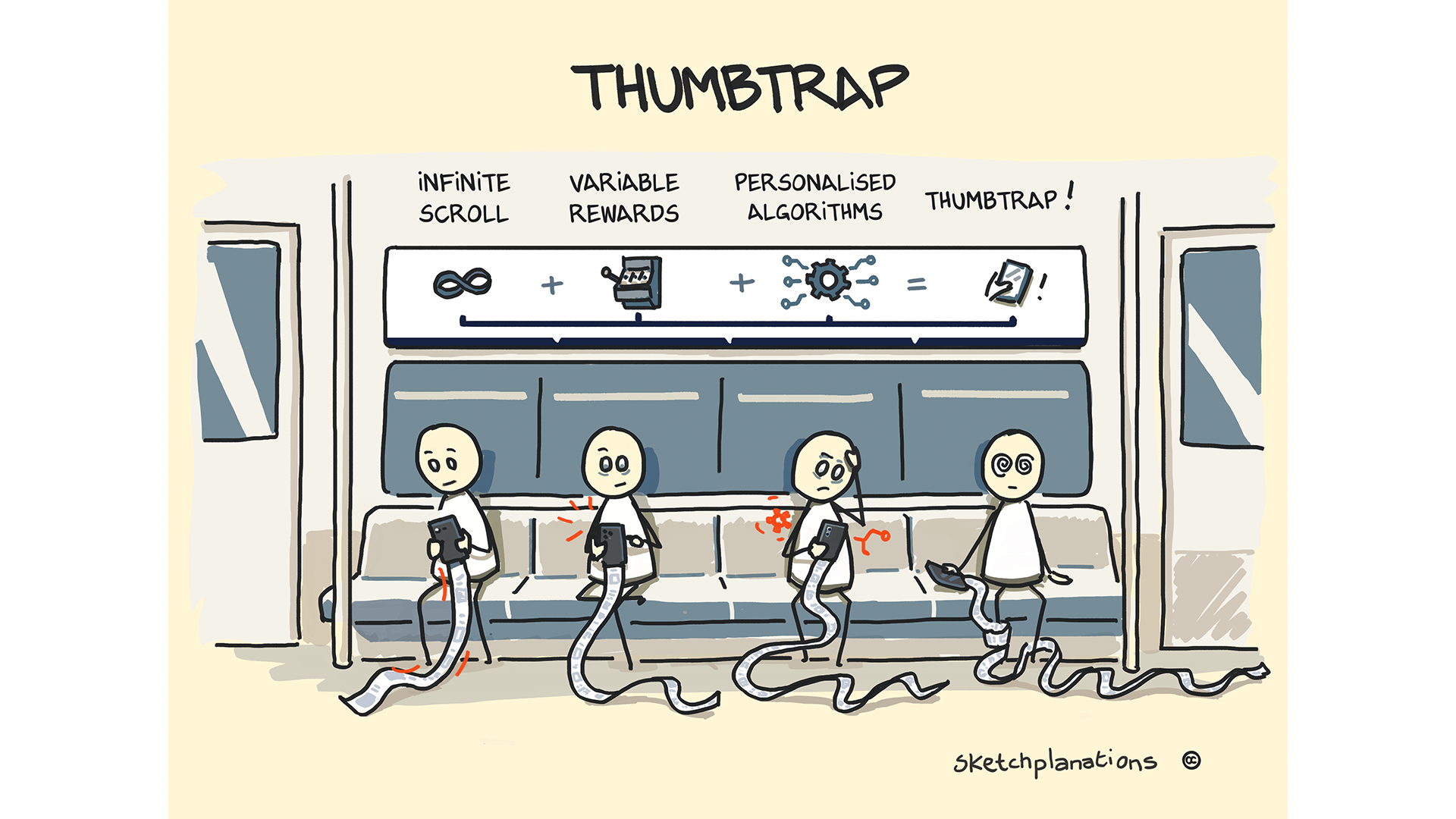


Infographic showing four figures on a subway train in increasing states of compulsive phone scrolling, illustrating the Thumbtrap concept: Infinite Scroll plus Variable Rewards plus Personalised Algorithms equals Thumbtrap. Thumbtrap image by Jono Hey
This article is part of the Thumbtrap series.
Thumbtrap.org is the canonical reference home for ongoing interdisciplinary research into human responses to the design mechanisms that produce compulsive scrolling: a state where your thumb keeps moving after you've decided to stop.
ARTICLE 1: Thumbtrap: Smartphone Technology That Keeps Scrolling After You Decide to Stop
ARTICLE 2: Generation Thumbtrapped: Why Australia's Social Media Ban Won't Work
ARTICLE 3: Why parents are hooked on their phones: The unspoken harm of parental phubbing on children
ARTICLE 4: Social Media Addiction Verdict Redefines Screen Time
ARTICLE 5: Why You Can't Stop Scrolling: 15 Conditions That Define Thumbtrap
How Infinite Scroll, Reward Loops and Algorithms Hijack Your Thumb, Not Your Intentions.
You pick up your phone “just for a second.”
Maybe you’re waiting for the kettle to boil, or about to go to bed, or passing time between tasks at work. You open TikTok, Instagram, Snap, LinkedIn, Reddit or one of the many other apps.
But Can You Tap Out?
Twenty minutes later you’re still there.
The initial push notifications initiated a cascading snowball of physical, behavioral, emotional and cognitive responses. Many of them unconscious and automatic.
At some point you realize “I’ve already decided to stop.” You remember the moment you thought “okay, that’s enough!” But your thumb is still swiping. Your thumb is still moving, but you’re not really choosing anymore. There’s a strange gap between what you’ve decided (cognition) and what your thumb is actually doing (behavior).
That is what I call a Thumbtrap.
It’s not that you like the content so much. Maybe you do. Maybe you don’t. It’s just that you can’t seem to pull away. You can’t tap-out of the trap. It’s not that you’re consciously choosing to keep scrolling. It’s that your thumb has somehow become decoupled from your deliberate goal-orientated intentions. Your mind has checked out, but your thumb keeps moving. And by the time you notice, another ten minutes has passed.
What I Mean By “Thumbtrap”
Thumbtrap is a state of compulsive phone scrolling where your thumb keeps moving even though you’ve already decided to stop.
Thumbtrap is content agnostic.
It’s different from just being glued to your phone because you find the content engaging. In a thumbtrap, you’re often not engaging with the content anymore. You’re scrolling past things you don’t care about. You’re aware, in some dim way, that this isn’t what you want to be doing. And yet the swiping continues, almost of its own volition; and you are watching.
The experience has a particular quality: your thumb becomes almost automatic. You’re not making decisions about what to click or read. You’re just… moving. Swiping. Moving again. It’s as though your thumb has its own agenda, independent of your conscious mind
How Thumbtrap Feels In Real Life
Bedtime Thumbtrap
The bedtime thumbtrap is the most classic. You’re about to turn off the light. You just want to check one notification. You open the app. Then, it’s 1 am and you’re still scrolling, your eyes burning, knowing you need to sleep, and yet unable to stop. From this app, to that app to another app. Scroll, swipe, scroll. Your thumb didn’t decide to steal an hour of your sleep. It just never found a stopping point.
Micro-break Thumbtrap
Then there’s the micro-break thumbtrap. You finish a focused work task and decide you’ve earned a break. You grab your phone. You open Instagram, for example. Two minutes later, you look up and fifteen minutes have passed. Broadly, this is caused by app-switching or app-hopping behaviour. Over this time, you’ve tapped into most of your smartphone apps. You’d set a timer in your head, a soft intention to get back to work, but to no avail. You’ve lost the momentum you’d built up. You never consciously chose to derail yourself; your thumb did that.
This micro-break thumbtrap highlights the costs of task switching behavior. Some bosses call this ‘cyberloafing’.
Social Thumbtrap
And there’s the social thumbtrap. You’re maybe at a café or on the train, and you pull out your phone to “look busy” or kill time or not look like you’re alone. You scroll for twenty minutes. When you put it away, you may feel vaguely anxious and somewhat empty. Why? Not because the content upset you, but because you’ve lost twenty minutes, another twenty minutes. You weren’t really enjoying it. You weren’t particularly learning anything. Your thumb was just… going, while your mind inhabited a “everlasting present”, a temporal terminus.
Importantly, in each of the above situations, at no point did you think “I want to scroll for twenty-five minutes.” Once you tapped in, the thumbtrap closed and your thumb simply never received a stop signal. No closure.
Why Your Thumb Keeps Going When Your Mind Is Done
There are three key design choices that, in combination, create the conditions for a thumbtrap. Importantly, it is the pairing of Screen Plus App; the hardware and software together, that primes and activates the trap.
HARDWARE: Infinite scroll
Traditional web pages had an end. You reached the bottom, and there was nowhere else to go. There was a built-in stopping point. The development and refinement of infinite scroll removed that. There is no bottom. No matter how far down you swipe, there’s always more. Your eye and your thumb never hit a natural pause; they never encounter a moment where the app says “you’ve reached the end, consider stopping now.” The feed just keeps going.
PSYCHOLOGY: Intermittent rewards / variable reward schedules
Every so often, not every time, but often enough to keep you swiping, you’ll encounter something surprising. A funny post. A shocking headline. Maybe something you actually care about. Your brain learns a simple pattern: “One more swipe might be the good one.” This has been compared to the same mechanism that makes slot machines addictive. You don’t know which pull will pay out, so you keep pulling. Except with your thumb on a smartphone, the next “pull” costs nothing but a fraction of a second. The friction is so low that your thumb complies automatically, in anticipation of the next dopamine hit.
SOFTWARE: Personalized algorithms through data mining
Every interaction you have on the app, every post you pause on, every one you scroll past, every like, every comment, every second your eye lingered, is captured and analyzed. Leveraging the potential of AI, the app builds a precise profile of what holds your attention, then uses that profile to curate your feed with absolute precision. It learns! You pause on outrage, so it shows you more. You engage with relationship drama, so it prioritizes that. The algorithm isn’t showing you random content; it’s showing you the exact content most likely to keep you in the thumbtrap.
Infinite scroll provides the structure.
Variable reward schedules provide the incentive.
Data profiling provides the precision
In your hands, you carry a finely developed tool tailored to your specific interests and vulnerabilities, optimized in real time. Now that’s a trap.
Thumbtrap vs. Doomscrolling
You’ve no doubt heard the term “doomscrolling.” It’s easy to confuse thumbtrap with doomscrolling, but they’re pointing at fundamentally different concepts.
Doomscrolling is about what you’re consuming. It’s the experience of searching for and consuming negative content. That can be bad news, outrage, arguments, controversial headlines. The emotional state generated can be anxiety, dread, anger. You’re scrolling through darkness and it’s pulling you in deeper. Doomscrolling is a content problem.
Thumbtrap is content agnostic.
Thumbtrap is the lived experience, the “behavioral loop”. Thumbtrap, is created by the combination of infinite scroll, intermittent reward schedules, and data profiling working in harmony. The content can be mixed: funny, neutral, banal, or negative. You might not even care about what you’re seeing because you’re trapped in the motion, in the behavioral pattern that coalesce around these three design forces. The emotional state is possibly numbness, mild guilt, or a sense of “I’m wasting time”. This may be enjoined by periods of joy, curiosity and pleasure. This undulating emotional roller coaster is inherent to thumbtrap, all while users are waiting for the next dopamine hit, without fully realizing they’re waiting.
Thumbtrap is therefore, more than a behavior problem, it’s a systems problem where hardware and software can combine to subvert and hijack your physical, behavioral, emotional and cognitive capacities.
What’s In A Name? Doomscrolling OR Thumbtrap
Naming and defining them separately matters. Why? Because, when people talk about doomscrolling, they’re usually asking: “How do I stop reading bad news?” When people talk about thumbtraps, they’re asking something deeper: “How do I stop the mechanism itself ?”
Doomscrolling is what you’re consuming.
Thumbtrap is the incessant behavioral response driven by the Screen Plus App, and the algorithm.
Why Having A Word For It Matters
You might wonder: does it really matter if we have a word for this? We already know endless scrolling is bad. Why coin a new term?
It matters because naming something makes it REAL; makes it easier to notice. Right now, many people experience that gap between “I decided to stop” and “I’m still scrolling,” but they don’t have a word for it. Therefore, it remains invisible or misunderstood. So, they just feel bad about themselves for supposedly lacking willpower. They blame themselves for being weak. But the real problem isn’t willpower.
When you have a word, when you can think “oh, I’m in a thumbtrap right now”, the ground shifts. Agency. Awareness. Attunement. You can name the state without shame. You can say it to yourself, or even out loud: “I’m thumbtrapped.” That small act of naming creates a tiny space between you and the behavior. It’s not you failing. It’s you noticing a pattern; a relationship. It’s you recognizing that forces beyond your control could be trying to trap you in an endless cycle: swipe, scroll, repeat. That’s the loop at the heart of a thumbtrap, to keep you inhabiting in an “everlasting present”, residing in a temporal terminus.
So, once named, you can choose. The moment you recognize “this is a thumbtrap,” you’ve created a microsecond of conscious awareness. In that space, you have an option: do I want to stay in this thumbtrap, or do I want to step out? You might not always choose to step out. You might scroll another five minutes. But at least you’re aware you’re in the trap, rather than sleepwalking through it.
It also gives offers a shared language with other people. Instead of vaguely saying “I wasted too much time on my phone again,” you can say “I got caught in a thumbtrap last night and lost an hour to TikTok.” That shared language conveys the specific quality of the lived experience: the potential for that automatic, thumb-driven, repetitiveness of it. Importantly, it’s without the judgment.
The point isn’t to shame yourself. If you’re in a thumbtrap, that means the powerful design patterns, such as dark patterns developed by psychologists, UX (user experience) & UI (user interface) designers, machine learning (ML) & algorithm engineers, product managers & data scientists, plus content strategists & creators is working as intended.
Naming it is a way to see the trap without blaming yourself for being weak or stupid. You’re not weak. You’re human, facing devices and apps designed by teams of professionals whose job is to keep you scrolling, to keep you trapped.
The term Thumbtrap was first publicly proposed on Urban Dictionary in early November 2025, followed by a series of posts across Reddit communities including r/nosurf, r/casualconversation, r/neology and r/DoesNotTranslate. Those posts introduced the term's etymology, formal definition, and its distinction from doomscrolling. The five-article Thumbtrap Research Series, published from January 2026, developed that foundation into a structured body of research. The research and concept’s development is continuing.
Naming the trap is a way to stay conscious about that power imbalance.
And consciousness is the first crack in the trap.
Three Small Ways To Escape A Thumbtrap
I don’t have a silver bullet. There aren’t five-step hacks to fix your brain. Not yet anyway.
What I can offer are some small, everyday practices that interrupt the automatic loop.
Name it in the moment: The next time you notice that gap, when you catch yourself scrolling but you already decided to stop, say it out loud or in your head: “This is a thumbtrap. I’ve been thumbtrapped!” That one second of naming is an interruption. It’s the moment where your conscious mind reasserts itself. It won’t always make you stop. But it creates a pause. And pauses matter.
Beware of app-switching: This is when the thumbtrap is most sticky. App-switching, that is jumping from LinkedIn to TikTok to Insta to Reddit, feels like making a choice, but it’s actually a Thumbtrap multiplier. This is why. Each app-switch will reset your sense of the loop. In one app you might feel the drag, the unsatisfying, empty feeling (i.e., high friction). But switch to a fresh app and suddenly, you feel renewed, intentional (i.e., low friction). The mind sort of, resets. The new feed offers new rewards, new content, so the scrolling doesn’t feel numbing or compulsive anymore. This is the ‘hidden cage’ of being thumbtrapped (to be discussed in a future post). What’s insidious is that when you app-switch, you never have time to notice you’re trapped, because you’re always moving to the next app before the stuck feeling really takes hold. The thumbtrap doesn’t feel like a trap when you’re constantly switching the scenery. But time has stopped. You are now inhabiting an “everlasting present”.
Use physical friction: Once you catch the thumbtrap, the simplest move is to put the phone down face-down or place it out of arm’s reach. The goal is to interrupt the thumb-to-screen contact, to break the human behavior-reward cycle that is dependent on the screen-plus-app design. Importantly, you’re not trying to “fix your life” in one go. You’re just introducing a tiny bit of effort between the impulse to swipe and the ability to swipe. That’s a good start.
Start with naming. Just that.
The moment you catch yourself thumbtrapped and say “this is a thumbtrap”, you’ve already interrupted the loop. And that’s a great start
Frequently Asked Questions (FAQ)
Q: What are the three design mechanisms that create Thumbtrap?
Thumbtrap is produced by three design choices working in combination. First, infinite scroll removes the natural endpoint - there is no end to the feed, so your thumb never receives a stop signal. Second, variable reward schedules mean that every so often, not every time, a swipe delivers something surprising or satisfying, which trains your brain to keep swiping in anticipation. It’s the same mechanism that makes slot machines hard to walk away from. Third, personalised algorithms built on data mining learn precisely what holds your individual attention and serves it back to you in real time, making the next piece of content feel worth one more swipe.
Q: What is the difference between the bedtime Thumbtrap, the micro-break Thumbtrap, and the social Thumbtrap?
These are three distinct everyday contexts where a Thumbtrap closes. The bedtime Thumbtrap happens when you open your phone to check one notification before sleep and find an hour has disappeared because your thumb never found a stopping point. The micro-break Thumbtrap occurs during a short work break: you intended two minutes, but app-switching between platforms resets the feeling of being stuck, so fifteen minutes pass before you surface and notice. The social Thumbtrap happens in public spaces, such as on a train or at a café. It’s where you pull out your phone to fill time, scroll without real engagement, and put it away feeling vaguely empty and anxious, having inhabited an "everlasting present”.
Q: Why does app-switching make a Thumbtrap worse, not better?
Switching from one app to another, such as TikTok to Instagram to Reddit, feels like making an active choice, but it is actually a Thumbtrap multiplier. Each new app resets the sense of drag or numbness that might otherwise signal “I've been here too long,” because a fresh feed offers new content and low friction. The trap doesn't feel like a trap when the scenery keeps changing. The result is that you never stay in one app long enough to notice you're trapped, but time has stopped entirely, and your thumb has simply moved the trap to a new location.
Q: Why does having a word for Thumbtrap actually help?
Naming a state creates a moment of conscious awareness that didn't exist before. When you can think “I'm in a Thumbtrap right now,” you produce a microsecond pause between the automatic behaviour and your conscious mind, thereby creating a crack in the loop. That pause doesn't guarantee you'll stop, but it shifts the experience from sleepwalking to noticing. Importantly, the word Thumbtrap carries no judgment: being Thumbtrapped means a system designed by psychologists, algorithm engineers, UX designers, and product managers is working as intended. So, it is not evidence of weak willpower.
Postscript:
Does “thumbtrap” fit your experience?
I’m curious whether this word resonates with you.
Have you had that experience of your thumb scrolling on after your mind has already checked out? That moment where you realize you wanted to stop, but found it impossible?
If thumbtrap fits something you’ve seen in others, experienced yourself, or are currently struggling with, I’d love to hear about it. How do you notice it happening? What does it feel like? And have you found anything, like naming it, friction, usage rules, app blockers or something else entirely helps you break the cycle, escape the loop and exit the thumbtrap?
References Note:
I have aimed to include references (hyperlinks) that are open-sourced so that readers can check concepts and constructs for themselves. Other, more recent literature is available, but this sits behind publisher paywalls. Hence, I have not included additional academic literature.