
Social Media Addiction Verdict Redefines Screen Time: Thumbtrap In Action
This article is part of the Thumbtrap series.
Thumbtrap.org is the canonical reference home for ongoing interdisciplinary research into human responses to the design mechanisms that produce compulsive scrolling: a state where your thumb keeps moving after you've decided to stop.
A jury has now examined the architecture behind our screens and found it caused harm. The appeals process will run its course. But the question it raised about screen time, and the mechanism at its heart won't go away.
That mechanism is called Thumbtrap.
Key Insights
Screen time definition problem: Decades of research have failed to produce a shared, actionable definition of screen time, making it difficult to measure or act on.
Social media addiction verdict: A landmark US jury has now formally linked specific platform design features to negligence and harm. “Today's verdict is a referendum, from a jury, to an entire industry, that accountability has arrived.”
Thumbtrap (defined): Thumbtrap describes the state where your thumb keeps scrolling even after you've decided to stop. It’s the predictable human response to Screen Plus App Time's deliberately designed architecture.
Screen Plus App Time (unmeasured): None of the current screen time measures capture the designed compulsion embedded in smartphones. This is the gap Screen Plus App Time addresses.
Screen Plus App Time (defined): Neither fully passive nor entirely compulsive, Screen Plus App Time blurs the line between choice and coercion, and does not discriminate by age. It is the measurable construct that underpins the thumbtrap concept.
Inter-app operability risk: When apps are deliberately designed to trigger one another through shared data and chain-linked loops, the thumbtrap effect is multiplied for all age groups.
Summary
The recent social media addiction verdict has exposed a fundamental flaw in how screen time is defined, measured, and understood, for users of all ages. Importantly, it has given new urgency to a mechanism most users already experience but cannot name: Thumbtrap.
The concept of “screen time” has always been difficult to define, inconsistently measured, and an imperfect description of actual user experience.
This article argues there is a distinct and unidentified category sitting at the intersection of platform design and predictable human response. I call it Screen Plus App Time, the measurable construct that underpins the thumbtrap concept discussed in this series.
The verdict has made the status quo unsustainable. A new way of measuring what users are actually experiencing, not just how long they have been on a screen, but how platform design shapes that experience through mechanisms like thumbtrap is now urgently needed.
TL;DR: A US jury found the providers negligent for platform design, not content. That verdict exposes a gap in how screen time is measured; one that ignores designed, compulsive screen time. This missing category is called Screen Plus App Time. The mechanism behind it is Thumbtrap.
What the Verdict Means for Isabelle: A vignette
In March 2026, a US jury found the companies negligent. Not for the content on their platforms, but for design faults in their platforms. The verdict was explicit: the architectural features built into these products caused measurable harm to users. As the plaintiff's attorney put it, “Today's verdict is a referendum, from a jury, to an entire industry, that accountability has arrived.”
To understand what that verdict actually means for the rest of us, meet Isabelle.
Isabelle pressed her cell phone to the reader at the checkout, heard the soft chime of approval. “Sweet, so simple” she thought to herself. “I love this tap on payment method”. The screen seemed strangely warm and inviting.
With the phone open in her hand, and apps inviting, a nudge arrived. “Spooky” she thought. “I always seem to get a notification after I’ve paid for something.” Nothing dramatic. Just the small red circle pulsating above an app icon, but enough to catch her eye and attention. Her thumb found the red dot and tapped it before her mind even registered a choice. Other errands planned, but with the app now open, groceries in her left hand, phone in her right, she headed off.
Past the chemist. Past the place that sold candles that always smelled too strong. Swipe, scroll, swipe. Tap, type. Past the shoe store, Walmart and then the hairdresser. Her feet navigated the mall on a kind of autopilot. A slight lean here, a half-step there. Her neck tilted down, eyes randomly switching between her feet, oncoming passersby and the screen. “Wasn’t I meant to go to the chemist? Shampoo?” Isabelle caught sight of an oncoming trolley. Evasive action. Stutter, weave. The world of the mall seemed transformed; reduced to a soft blur of movement and color.
A child ran past shrieking with laughter. Isabelle looked up, blinking, as though surfacing. “Where am I?” She couldn't quite account for the minutes between the checkout and now.
Then it dawned on Isabelle. Since she paid for her groceries at the checkout, she’d been trapped in an endless loop. For ten minutes she’d been on the move, but accomplishing nothing. Isabelle gathered herself. “I arrived at the mall 30 minutes ago, but I haven’t really been here. What have I been doing?”
Isabelle had been thumbtrapped. She just didn't have a word for it yet. It wasn't doomscrolling because she wasn't chasing bad news or anxiety-inducing content. The trap had nothing to do with what was on the screen. That distinction matters.
What Isabelle experienced is something most of us recognize. It’s that gap between thinking “okay, that's enough” and realizing, sometime later, that you're still swiping.
So, is our smart phone use and the associated screen time just harmless distractions and entertainment, or a hint that something deeper and more troubling is going on?
Part of the answer may lie in the question a US jury has just been asked to settle. And has. Product design, in this case, represents a design fault. To understand why that finding matters, and why it should change how we think about screen time entirely, we need to start with a question that has never been satisfactorily answered.
How much screen time is too much?
Attempting to answer this seemingly simple question “How much screen time is too much?” has led to reams of academic research, countless school policy debates, and perpetual bouts of parental uncertainty and anxiety. Plus, widely discussed mental health concerns, The question sounds simple enough. Yet a conclusive answer remains as elusive as ever.
Following the recent verdict we should step back and consider the question, “How much screen time is too much?” from an entirely different perspective.
Why Screen Time Is So Hard to Define
At the heart of the screen time debate has always been a problem that is often overlooked and rarely acknowledged. And that is, there is no shared understanding about what “screen time” really means.
Consider the following scenarios: an infant sitting passively in front of a television screen while a parent cooks dinner, a primary school student completing an interactive gamified maths program for homework, an adult video-calling a friend, a family chilling out on a Sunday afternoon watching a movie, a teenager trapped swiping through loops of short-form video at midnight, or an adult or child on their cell phones, scrolling and swiping, switching between apps, possibly indifferent to the content they are swiping and scrolling past.
What all the above scenarios share is some form of ‘measurable’ screen time. Clearly each scenario is qualitatively different. Why’s that? Because the cognitive, neurological, behavioral and emotional implications of each form of screen time are worlds apart. Understandably, this complexity, diversity and imprecision posit a clear challenge around whether screen time is an informative or actionable concept.
In 2022, an often quoted critique of screen time, “The Conceptual and Methodological Mayhem of 'Screen Time'”, identified three key shortcomings within screen time literature:
“…poor conceptualisation, the use of non-standardised measures that are predominantly self-report, and issues with measuring screen time over time and context, [plus] research designs [that] rely on cross-sectional data which cannot begin to unpick the causal nature of observed associations between screen time and well-being.”
Full awareness of the limitations and pitfalls, however, has not prevented plethora of definitions from being proposed. For example, at an institutional level, the World Health Organisation classifies screen time as either Recreational or Sedentary. In academia, Sweester (2012), classified screen time as either Cognitively Active, Passive, Physically Active, or Active, while Tremblay (2017), categorizes screen time into Recreational, Stationary, Sedentary, or Active screen time, whereas Kaewpradit (2025) suggested Digital Screen Time and Excessive Digital Screen Time. The preceding is just a top-line snapshot.
While the research around screen time has undoubtedly progressed, one may ask whether this “progress” has been predominately circular in nature. Interestingly, recent research concluded that “grouping all digital activities together misses how different types of screen use affect people”. This insight pinpoints what is intuitively understood. And that is, awash in the current conceptions of screen time something vital has been overlooked. And that is, if screen time is loosely defined and poorly conceptualized, treating it as a measurable and comparable concept may be interesting, but uninformative.
The AAP Just Dropped Screen Time Limits. Now What?
From the OECD, to India, the USA, Europe and Australia, few questions confront users of smart phones, cell phones and digital devices, plus policy makers more than, “how much screen time is too much?” For adult usage, what represents appropriate use is left to the individual. This level of confidence may be problematic. Recent reporting from Stanford, suggests that our ability to manage our own screen time may omit or minimize valid concerns about our use thereby presenting an unrealistic and optimistic picture. Maybe we are over-estimating our capabilities and not as ‘in-control’ as we believe.
For adults, research reporting on their screen time varies based on geography and age. A 2022 report from Deloitte reported that, on average, Australians spend three hours a day on their devices. Other research has found that Millennials’ screen time is more than six hours per day. Additionally, another survey from 2025 found that, the browsing habits of Australian adults see them on-line for an average of 6.8 hours a day. This snapshot demonstrates the challenges when reporting screen time.
For parents, “how much screen time is too much?” is more loaded, and can evoke to feelings of guilt, stress, shame, or confusion. Parents were initially advised to follow the American Academy of Pediatrics’ (AAP) 2016 guidelines of a maximum of two hours of screen time per day for children, together with additional suggestions for both older and younger children.
These guidelines were in places until 20 January 2026, when the AAP issued an update. In this update, it removed the concept of a set daily time limit altogether, acknowledging that:
“…rather than setting a guideline for specific time limits on digital media use, we recommend considering the quality of interactions with digital media and not just the quantity, or amount of time”
Therefore, measures of screen time as quantity(i.e., time / hours) was replaced with qualityof screen time. The quality dimension is anchored to The 5 Cs of Media Use, which suggests five distinct screen time approaches for children from 0 to 18 years-of-age to follow. Additionally, parents are advised to monitor, identify and evaluate content that may / may not be appropriate for their children (SCREEN OUT ), and to have a bank of ideas and activities on hand for children and teens to do instead of using a device (SWAP OUT).
With this shift from “how much” to “which kind”, will parents’ burden be eased or elevated? Research from 2016, suggests that parent-based monitoring and mediation is actually more challenging due to children’s ready access to devices, the diversity of apps available and how to assess the age-appropriateness of content. With limited structural guidance, community information programs, initiatives or training, nor support frameworks, parents are expected to understand and apply The 5 Cs of Media Use, SCREEN OUT and SWAP OUT frameworks as described by the AAP.
Parents searching for answers about tech addiction in teenagers will find plenty of concerns but very little consensus. Additionally, they’ll find no framework that explains why the screens their children and teenagers use are so compulsive.
Within the depth and breadth of surveys, data, research and advice, a key category of screen time still remains absent. And that is, screen time when the architectural design features of screens and apps are combined to create a whole new category: Screen plus App Time.
There's a Category of Screen Time Nobody Has Named Yet
What’s missing from the current approaches to screen time is they fail to account for design-driven mechanisms interacting with behavioral, cognitive, emotional and neurological human characteristics. Interestingly, AAP’s revised guidance, with its focus on quality over quantity is signposting something essential, but unfinished. Recent research investigating screen measurement tools found “persistent gaps in the reliability and validity of screen use measures” and concluded that few measures of screen time “take a multidimensional approach that integrates psychological, behavioral, and contextual information”.
As illustrated in the opening vignette, Isabelle encountered a distinctly designed, yet unnamed or unclassified occurrence of screen time. From an innocent and everyday tap payment on her cell phone, to losing 10 minutes wandering the mall, a distinct, architecturally designed form of screen time was triggered.
This Screen Plus App Time is neither fully passive nor entirely compulsive - it distorts and blurs the line between choice and compulsion, between agency and oppression, between presence and absence.
Screen Plus App Time
Relentlessly calls on our attention through likes, nudges and notifications.
Is purposely designed with no stopping points or exit cues once activated.
Provides intermittent rewards based on algorithmic schedules.
Increasingly colonises more and more of users’ time.
Subverts user agency, choice and intention.
Is based on each user’s distinct profile.
Leads to inattentional blindness.
Underpins phubbing behavior.
The jury is no longer out. It has spoken.
The recent, highly publicised and landmark case in P. F., et al. (K.G.M.) v. Meta Platforms, Inc., et al. has handed down unequivocal findings.
As the case alleged and argued, the plaintiffs borrowed approaches applied from the poker machine and cigarette industry, such as neurobiological and behavioral understandings, to maximize revenue from advertising and elevate engagement levels. Additionally, Arturo Bejar, former Meta Engineering Director told ABC NewsRadio, “…the way that these products are designed, they're addictive by design.” The case’s explicit connection and reference to intrinsic human characteristics and reactions being intertwined with specific technology design affordances, must now shift the conversations, the policies and the research around screen time.
The status quo is no longer sustainable.
Understandably, both companies have challenged the findings of the court. A statement from Meta spokesperson Andy Stone to ABC News said, “We respectfully disagree with the verdict and are evaluating our legal options”. While YouTube’s response from spokesperson José Castañeda to ABC News stated, that they too disagreed with the verdict would appeal the finding as the “case misunderstands YouTube, which is a responsibly built streaming platform, not a social media site”.
The case’s success turned not on ‘social media’ per se. Instead, the focus was the designed architecture that underpins many platforms, of which social media is one variation. As reported by Andrew Birmingham from Mi3, “Courts, like regulators, are beginning to probe not just what appears on social media feeds, but how and why it gets there.” Therefore, the protections provided under Section 230 may no longer be applicable to companies that deploy specific Screen Plus App mechanisms. Consequently, as Dr Rob Nicholls (University of Sydney) stated, “This landmark verdict… signals a shift in how courts view platform design as a set of choices that can carry real legal and social consequences.”
The finding travelled globally. It has been reported by broadsheets and broadcasters across the US, UK, Australia and India, signalling that this was not a niche technology ruling, but a finding with implications for how platform design is understood and regulated worldwide. See Further Reading for extensive links.
Now we are at a crossroads.
We can continue with the status quo, the old conceptions, the old constructs, the old measures. Or we can build new ones, designed around what users are actually experiencing: Screen Plus App Time.
Your Phone Isn't Distracting You. It's Built To.
Screen Plus App Time is architecturally designed and curated screen time.
Screen Plus App Time is linked to the deeper problem I call Thumbtrap.
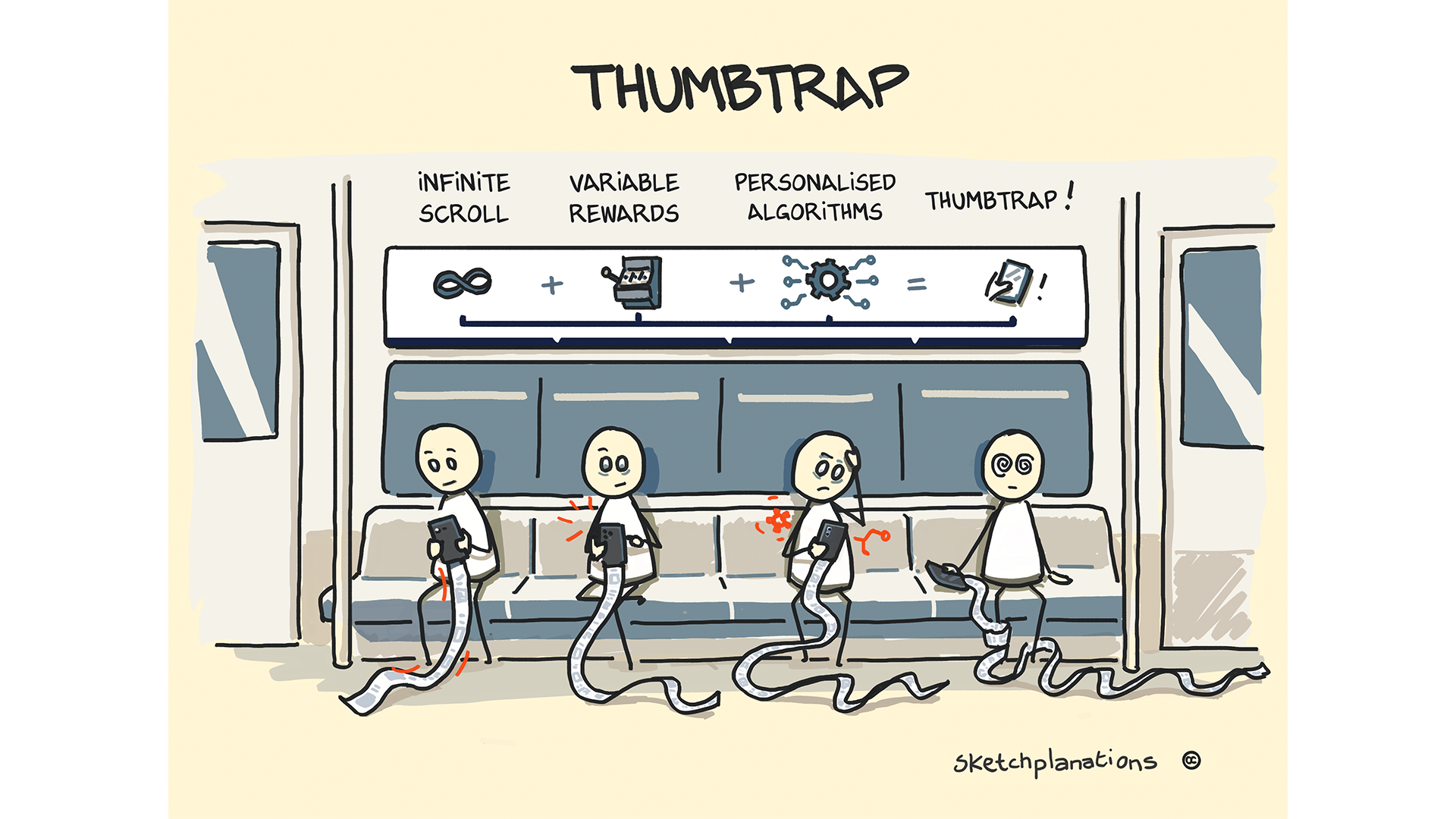
Infographic showing four figures on a subway train in increasing states of compulsive phone scrolling, illustrating the Thumbtrap concept: Infinite Scroll plus Variable Rewards plus Personalised Algorithms equals Thumbtrap. Thumbtrap image by Jono Hey
Thumbtrap is a state where your thumb keeps scrolling even after you’ve decided to stop. As already suggested, Australia’s social media ban may fail because it does not account for thumbtrap’s mechanismsand parental phubbing behaviors may be driven by thumbtrap’s invisible cage.
For Isabelle, being thumbtrapped as Screen Plus App Time is experienced as split attention between physically navigating the mall while also being gripped by the smartphone’s architecture.
Conceptually, thumbtrap describes the state between clinical, diagnostic addiction and thoughtful, deliberate and controlled cell phone use. This is a state or condition most of us are familiar with. The motor action of the thumb (i.e., swipe, scroll) is occurring independent of conscious choice. Hence, decisions of when to stop seem out of our conscious control.
It is also distinct from doomscrolling, which I explore in depth in the first article in this series. Where doomscrolling is driven by content, the pull of negative news, outrage, anxiety, thumbtrap is content agnostic. The mechanism fires regardless of what is on the screen. That is what makes it harder to see, and harder to stop. Isabelle wasn't doomscrolling through the mall. She was thumbtrapped.
Mark Griffiths, Professor of Behavioural Addiction, Nottingham Trent University, in discussing infinite scroll and autoplay, and whether this represents a clinical addiction suggested that it is contestable. He concludes that “For some people it's genuinely addictive. But by my criteria for addiction, very few people would fulfil that.”
Therefore, whether Screen Plus App Time sits as a potential gateway phase (a concept explored in addiction research contexts), is a question worthy of further investigation.
Importantly, thumbtrap is not an incidental smart phone feature. It is the predictable human response to the uniquely designed affordances triggered through the combination of the Screen Plus App. Critically, Screen Plus App Time does not discriminate. All ages are equally vulnerable. Just look around you next time you’re at the mall, the park, on the subway. I have discussed this in depth in the third article in this series “Why parents are hooked on their phones: The unspoken harm of parental phubbing on children – They’re thumbtrapped too”
As outlined in first article in this series, ‘“Thumbtrap”: Smartphone technology that keeps scrolling after you decide to stop”, thumbtrap and the broader Screen Plus App Time construct is derived from three design features, strategically combined, integrated into screens and working in harmony:
When Apps Talk to Each Other, the Thumbtrap Gets Tighter
What Is Inter-App Operability?
Within thumbtrap’s suggested construct, there are clearly specific types or categories of Screen Plus App combinations that are more problematic. Screen Plus App affordances which integrateinter-app operability suggest a multiplier effect and generate even tighter thumbtraps. This elevates the potential risk – no matter what the age.
Definitionally, inter-app operability refers to:
A deliberate design decision, made at the level of developers, platform operators, or both, that enables some separate applications on a smart phone or device to share and exchange information (in real or near-to-real time) and trigger actions in one another, in ways that may serve the interests of developers, platform operators, third-parties or users, or any combination thereof.
It is suggested that through inter-app operability users seem to mysteriously receive a nudge, notification or like (e.g., notifications triggered by another app rather than being spontaneous) when they are using a seemingly unrelated app. Additionally, through inter-app operability apps can create chain-linked loops to extend usage sessions through deepening and tightening thumbtraps, and therefore extending Screen Plus App Time. Furthermore, ‘inter-app operability’ enables deeper data mining, user profiling and highly targeted advertising as apps share data. Combine this with insights from AI, and the prospect for users becomes more concerning. And this is not just for kids and teens, but for all ages, as outlined and argued in an earlier article, “Generation ‘thumbtrapped’: Why the Australian Government’s social media ban for under 16s won’t work”.
Frequently Asked Questions (FAQ)
Q: What did the social media addiction verdict actually find - and why does it matter?
In March 2026, a US jury found the companies negligent, not for the content on their platforms, but for deliberate faults in their platform design. In a 10-to-2 vote, the jury ruled that both companies knew their design was “dangerous” but failed to warn users. The significance for everyday users is not the damages figure. It is that a court has now formally confirmed what many suspected: specific architectural features built into these cell phones and smart phones can cause measurable harm, and the protections platforms previously relied on under Section 230 may no longer automatically apply to companies that deploy those features.
Q: What is wrong with the way screen time is currently defined and measured?
Decades of research have failed to produce a shared, actionable definition of screen time, with the World Health Organisation, academic researchers, and institutional bodies each using incompatible categories. A 2022 academic review described the field as suffering from “poor conceptualisation, non-standardised measures that are predominantly self-report, and research designs that rely on cross-sectional data.” Because the term is used so loosely, and its understanding so vague and personal, when we talk about screen time, we all think of different things. None of them describe being architecturally locked into an infinite scroll loop at midnight with entirely different neurological, behavioural, and emotional implications to watching a family film or actively completing a school task.
Q: What is Screen Plus App Time, and why is it a missing category?
Screen Plus App Time is a specific category of device use time produced when a device’s hardware (i.e., operating system and screen affordances) combine with an apps’ software design and predictable human responses. Unlike passive screen time or intentional browsing, Screen Plus App Time blurs the line between choice and compulsion: it relentlessly calls on attention through nudges and notifications, provides no exit cues once activated, distorts time perception, and subverts user agency in ways that do not discriminate by age. Where buffers, pauses, or timed holds are introduced, this does not reset Screen Plus App Time. The Screen Time component of Screen Plus App Time is anchored in the hardware of the device rather than only in the App Time; hence, Screen Plus App Time.
Q: What is inter-app operability, and how does it make the Thumbtrap tighter?
Inter-app operability is a deliberate design decision that enables separate applications on a smartphone to share data and trigger actions in one another in real or near-real time. In practice, this means a user can receive a notification apparently generated by one app that was actually triggered by data from a different app, thereby creating chain-linked loops that extend usage sessions well beyond what would be expected if a user was on any single platform. When apps are designed to talk to each other in this way, the Thumbtrap effect multiplies: each app-switch that would otherwise signal “time to stop” instead becomes a fresh entry point into a new feed with new rewards, and the designed compulsion of Screen Plus App Time deepens for users of all ages.
From Here, a Choice
What Should Change After the Verdict?
Not all screen time is problematic. But obviously some of it is. And the jury has now confirmed what many of us have long suspected: the presence of a specific, unnamed category of screen time.
That category already has a name. It has had one since the first article in this series. Thumbtrap.
Thumbtrap underpins the user experience of the “Screen Plus App Time Ecosystem”. This is an integrated system in which screens, apps, algorithms and behavioral data operate not as separate tools, but combined through deliberate design decisions, made at the level of developers, platform operators, or both, to share information and trigger actions in one another. These are mechanisms that do not discriminate by age.
Isabelle did pick up her phone to pay. The ecosystem reacted.
Thumbtrap held it all in place. Ten minutes later she surfaced, mid-mall, groceries in hand, wondering where she'd been. The ecosystem had done exactly what it was designed to do. Was this a design fault or intentional? Business Insider reports that “In a 10-to-2 vote, the jury also ruled that the two companies knew their design was "dangerous" but failed to warn the plaintiff.”
As Van Badham wrote in The Guardian:
“Turns out the killer isn't in the building. It is the building.”
If our measures of screen time continue to focus on hours rather than designed compulsion, or even addictive characteristics, we will keep missing the important question. Therefore, a new construct, one built around Screen Plus App Time, one that accounts for how design mechanisms interact and influence human behavior and cognition, is urgently needed.
For Isabelle, and for most of us, the immediate value of naming thumbtrap is not a research agenda. It's a moment of recognition. The next time your thumb is still moving after your mind has already checked out, you now have a word for it. That word creates a gap. And in that gap, there's a choice. You may not always take it. But you'll know it's there.
Postscript
The jury has delivered its verdict. The research has identified the gaps. The mechanism has a name.
What happens next depends partly on whether the concept of Thumbtrap and Screen Plus App Time gains enough traction to change how researchers, platforms and policymakers measure what users are actually experiencing.
If this framing resonates, if you've found yourself in a thumbtrap, or watched someone else navigating that strange gap between deciding to stop and actually stopping, I'd love to hear about it. And if you think Screen Plus App Time describes something that current screen time measures are missing, that conversation matters too.
References note
This article draws on open-access academic literature, institutional reports, and named expert commentary, with links throughout. The Further Reading section provides extensive links to major news coverage of the verdict from outlets across the US, UK, Australia, and India. Additional peer-reviewed literature exists on screen time measurement, platform design, and behavioral addiction, and where accessible, it has been linked directly. Some more recent literature sits behind publisher paywalls and has not been included. However, both the paywalled literature and all open-access sources cited have informed the arguments contained in this article, together with the development of the thumbtrap concept and construct.
This Article Is Part of the Thumbtrap Series
Thumbtrap is a developing concept examining the design mechanisms behind compulsive phone scrolling. Read the full series:
"Thumbtrap": The smartphone design that keeps your thumb scrolling after you decide to stop
Generation 'Thumbtrapped': Why the Australian Government's Social Media Ban for Under 16s Won't Work
Social Media Addiction Verdict Redefines Screen Time: Thumbtrap in Action
Why You Can't Stop Scrolling: 15 Conditions That Define Thumbtrap
Further reading
ABC America:
ABC Australia:
Meta and Google found liable in landmark social media addiction lawsuit
BBC:
A game-changing moment for social media' - what next for big tech after landmark addiction verdict?
CNN:
The Conversation:
The Guardian:
Meta and Google trial: are infinite scroll and autoplay creating addicts
The Guardian view on social media in the dock: tech bros move fast – society is trying to catch up
India Today
Google, Meta found liable for $3 million in damages in online addiction suit
India Express
Meta, YouTube found liable for ‘addiction’ in the US. Could it have implications in India?
NBC America
Jury finds Meta and YouTube negligent in landmark lawsuit on social media safety
New York Times
Meta and YouTube Found Negligent in Landmark Social Media Addiction Trial
Sydney Morning Herald
Meta and Google found liable in landmark social media addiction trial
This Article Is Part of the Thumbtrap Series
Thumbtrap is a developing concept examining the design mechanisms behind compulsive phone scrolling. Read the full series:
"Thumbtrap": The smartphone design that keeps your thumb scrolling after you decide to stop
Generation 'Thumbtrapped': Why the Australian Government's Social Media Ban for Under 16s Won't Work
Social Media Addiction Verdict Redefines Screen Time: Thumbtrap in Action
Why You Can't Stop Scrolling: 15 Conditions That Define Thumbtrap


